
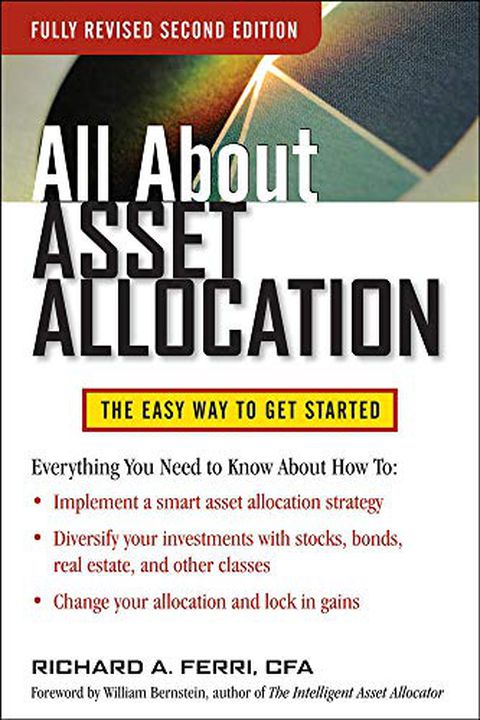
All About Asset Allocation, Second Edition
by Richard Ferri
Reading Profile
Should I read this?
A plain, pragmatic guide to choosing and adjusting asset mixes for long-term investors. The text leans on concrete allocation examples, target mixes, and clear rebalancing rules across stocks, bonds, real estate, and other classes, with many tables and sample portfolios. Most useful are the step-by-step implementation cues and timing guidance for locking in gains. Its limitations are a conservative, prescriptive tone and repetition of examples that can feel redundant for readers who already know the basics or want deeper quantitative detail.
Read this if...
- •a DIY retiree assembling a low-volatility portfolio who wants clear target mixes and straightforward rebalancing rules to implement now — helpful when you want concrete steps rather than market speculation
- •an early-career financial advisor who must explain allocation basics to skeptical clients — likely to find simple language and ready examples to walk clients through tradeoffs
- •a mid-career investor shifting from single-stock exposure to diversified holdings who needs step-by-step instructions for setting and monitoring allocations without heavy math
Skip this if...
- •you'll likely put it down when the text repeats allocation tables and prescriptive examples — readers wanting varied narratives or dense quantitative argument may find that repetition tedious
- •annoying if you prefer heavy quantitative models or academic-level detail — the book favors plain guidance over in-depth math and model-building
- •frustrating if you wanted hands-on practice or interactive tools — the book lacks exercises and workbook-style simulations to test allocation choices
WHEN IT COMES TO INVESTING FOR YOUR FUTURE, THERE'S ONLY ONE SURE BET?ASSET ALLOCATION THE EASY WAY TO GET STARTED Everything You Need to Know About How To: Implement a smart asset allocation strategy Diversify your investments with stocks, bonds,real estate, and other classes Change your allocation and lock in gains Trying to outwit the market is ...
Before You Buy
Reading Specifications
Difficulty:easy
Audience Fit
- a DIY retiree assembling a low-volatility portfolio who wants clear target mixes and straightforward rebalancing rules to implement now — helpful when you want concrete steps rather than market speculation
- an early-career financial advisor who must explain allocation basics to skeptical clients — likely to find simple language and ready examples to walk clients through tradeoffs
- a mid-career investor shifting from single-stock exposure to diversified holdings who needs step-by-step instructions for setting and monitoring allocations without heavy math
- you'll likely put it down when the text repeats allocation tables and prescriptive examples — readers wanting varied narratives or dense quantitative argument may find that repetition tedious
- annoying if you prefer heavy quantitative models or academic-level detail — the book favors plain guidance over in-depth math and model-building
- frustrating if you wanted hands-on practice or interactive tools — the book lacks exercises and workbook-style simulations to test allocation choices
Check formats, pricing, and availability options for Kindle, physical print, or audiobooks directly.
View available editions on AmazonKey themes
Why recommended
appears in Best Investing Books, Finance, and Nonfiction.
Recommendation Signals
Recommendation proof is sourced from public posts, interviews, reading lists, and cited references.
No verified recommendation proof available yet.
Appears In
Not sure if this is the right fit?
Consider The Undoing Project by Michael Lewis. Recommended by 18 sources.
“Michael Lewis chronicles the friendship and intellectual partnership of Daniel Kahneman and Amos Tversky, who championed the idea that cognitive biases shape our choices. The narrative reads like a buddy story, weaving their discoveries into personal anecdotes and the drama of their collaboration. You'll grasp key ideas—loss aversion, framing—through their story, but the book focuses on biography, not application. Helpful for understanding behavioral economics' origins; less useful if you want actionable advice. The emotional arc of their relationship can overshadow the science.”
Similar books
The Undoing Project
Michael Lewis
The Little Book of Common Sense Investing
John C. Bogle
Financial Shenanigans
Howard Schilit
Scale
Geoffrey West
Poor Numbers
Morten Jerven
The Great Illusion
Norman Angell
One Billion Americans
Matthew Yglesias
Accounting Principles Standalone book
Jerry J. WeygandtHow recommendation signals are reviewed
Each recommendation is collected from a public source — interviews, articles, or curated lists — and linked to its original URL. Books with many verifiable recommendations from respected people rank higher.