
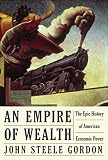
An Empire of Wealth
The Epic History of American Economic Power
by John Steele Gordon
Recommended by Paul Graham and Meb Faber
Check price on AmazonProof-backed recommendation
Amazon availability
Reading Profile
Should I read this?
An Empire of Wealth argues that American global dominance rested more on the generation of staggering private wealth than on conquest. The prose moves between broad historical sweep and close financial episodes, offering useful chronological connective tissue between Rome, Britain, and modern America. The book's useful part is its long-view tracing of institutions and capital; its main limitation is uneven depth—chapters sometimes dwell on arcane monetary detail and anecdotal listings instead of sustained critical synthesis.
Read this if...
- •a history graduate student drafting a seminar paper on economic foundations of U.S. power — good for assembling chronological examples that tie finance to influence
- •a finance professional or business journalist building background on long-term market drivers — useful as color-rich case studies linking institutions to capital accumulation
- •a policy analyst preparing a briefing on soft power and economic statecraft — helps map how private wealth and institutions contributed to national leverage across eras
Skip this if...
- •you'll likely put it down when chapters turn into long, arcane financial case studies and lists of institutions — the narrative can drag if you prefer concise argument over empirical cataloguing
- •annoying if you prefer a sharply critical take: the tone often explains and contextualizes wealth rather than interrogating inequalities or coercive practices in depth
- •not a fit if you wanted actionable lessons or step-by-step policy prescriptions — no exercises or hands-on how-to content here
Throughout time, from ancient Rome to modern Britain, the great empires built and maintained their domination through force of arms and political power. But not the United States. America has dominated the world in a new, peaceful, and pervasive way through the continued creation of staggering wealth. In this authoritative, engrossing history, J...
Before You Buy
Reading Specifications
Difficulty:hard
Audience Fit
- a history graduate student drafting a seminar paper on economic foundations of U.S. power — good for assembling chronological examples that tie finance to influence
- a finance professional or business journalist building background on long-term market drivers — useful as color-rich case studies linking institutions to capital accumulation
- a policy analyst preparing a briefing on soft power and economic statecraft — helps map how private wealth and institutions contributed to national leverage across eras
- you'll likely put it down when chapters turn into long, arcane financial case studies and lists of institutions — the narrative can drag if you prefer concise argument over empirical cataloguing
- annoying if you prefer a sharply critical take: the tone often explains and contextualizes wealth rather than interrogating inequalities or coercive practices in depth
- not a fit if you wanted actionable lessons or step-by-step policy prescriptions — no exercises or hands-on how-to content here
Check formats, pricing, and availability options for Kindle, physical print, or audiobooks directly.
View available editions on AmazonKey themes
Why recommended
Recommended by 2 sources and appears in Books Recommended by Paul Graham, Finance, and History.
Recommended by notable people
People and public figures who have recommended this book.
Recommendation Signals
Recommendation proof is sourced from public posts, interviews, reading lists, and cited references.

Paul Graham
Co-founder of Y Combinator; essayist
“Recently enjoyed reading Americana by @bhu_srinivasan ... Any other favorite books on economic history Three more favorites: Birth of Plenty/Splendid Exchange by Bernstein Empire of Wealth by Gordon Ascent of Money by Ferguson”
Appears In
Not sure if this is the right fit?
Consider The Undoing Project by Michael Lewis. Recommended by 18 sources.
“Michael Lewis chronicles the friendship and intellectual partnership of Daniel Kahneman and Amos Tversky, who championed the idea that cognitive biases shape our choices. The narrative reads like a buddy story, weaving their discoveries into personal anecdotes and the drama of their collaboration. You'll grasp key ideas—loss aversion, framing—through their story, but the book focuses on biography, not application. Helpful for understanding behavioral economics' origins; less useful if you want actionable advice. The emotional arc of their relationship can overshadow the science.”
Similar books
The Undoing Project
Michael Lewis
The Little Book of Common Sense Investing
John C. Bogle
Financial Shenanigans
Howard Schilit
Scale
Geoffrey West
Poor Numbers
Morten Jerven
The Great Illusion
Norman Angell
One Billion Americans
Matthew Yglesias
Accounting Principles Standalone book
Jerry J. WeygandtHow recommendation signals are reviewed
Each recommendation is collected from a public source — interviews, articles, or curated lists — and linked to its original URL. Books with many verifiable recommendations from respected people rank higher.