
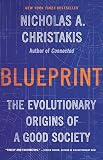
Blueprint
The Evolutionary Origins of a Good Society
by Nicholas A. Christakis


3 more
More Recommenders
Author, essayist, mathematical statistician, and risk analyst
“BLUEPRINT by @NAChristakis is a terrific book that is optimistic about the human condition and that explores the evolutionary origins of a good society. It's a joy to read and it highlights ways to make our society better. via @littlebrown | Excited to get the book of @NAChristakis as I am trying to go deeper into the notion of fractal (multiscale) localism & see what's wrong w/my thesis: It isn't individuals vs societies but fractal gradations, each w/specific dynamics, (contra the selfish gene philosophastering) | I cannot recommend too highly the new book by @NAChristakis: One of the finest and most humane minds of our time. | In his terrific book Blueprint, Christakis explains that humans have evolved to work together and be social. Although this instinct originally developed because it made us more likely to live longer, our need to form groups has had a huge impact on human history.”
Source →“BLUEPRINT by @NAChristakis is a terrific book that is optimistic about the human condition and that explores the evolutionary origins of a good society. It's a joy to read and it highlights ways to make our society better. via @littlebrown | Excited to get the book of @NAChristakis as I am trying to go deeper into the notion of fractal (multiscale) localism & see what's wrong w/my thesis: It isn't individuals vs societies but fractal gradations, each w/specific dynamics, (contra the selfish gene philosophastering) | I cannot recommend too highly the new book by @NAChristakis: One of the finest and most humane minds of our time. | In his terrific book Blueprint, Christakis explains that humans have evolved to work together and be social. Although this instinct originally developed because it made us more likely to live longer, our need to form groups has had a huge impact on human history.”
Source →“BLUEPRINT by @NAChristakis is a terrific book that is optimistic about the human condition and that explores the evolutionary origins of a good society. It's a joy to read and it highlights ways to make our society better. via @littlebrown | Excited to get the book of @NAChristakis as I am trying to go deeper into the notion of fractal (multiscale) localism & see what's wrong w/my thesis: It isn't individuals vs societies but fractal gradations, each w/specific dynamics, (contra the selfish gene philosophastering) | I cannot recommend too highly the new book by @NAChristakis: One of the finest and most humane minds of our time. | In his terrific book Blueprint, Christakis explains that humans have evolved to work together and be social. Although this instinct originally developed because it made us more likely to live longer, our need to form groups has had a huge impact on human history.”
Source →Recommended by 5 notable people, including Bill Gates and Adam Grant
Check price on AmazonProof-backed recommendation
Amazon availability
Reading Profile
Should I read this?
Reading it feels like a wide-angle take on human social life: readable chapters that alternate clear summaries of studies, historical anecdotes, and speculative connections. Its useful part is reframing everyday institutions—family, friendship, cooperation—as products of positive biological tendencies, delivered in plain language that invites curiosity. Main limitation: frequent repetition and broad generalizations mean readers who want technical rigor or sustained counterargument will feel shortchanged; some chapters verge on cheerleading rather than careful nuance.
Read this if...
- •public-health graduate student building a case for community-based interventions who needs an accessible, biologically-inflected narrative to persuade non-specialist stakeholders
- •high-school or college civics teacher planning a unit on social cooperation who wants readable stories and examples to spark classroom discussion
- •product manager at a social platform arguing for features that encourage positive interaction and looking for an approachable framing about why social ties matter
Skip this if...
- •you'll likely put it down when the same examples and upbeat conclusions repeat — midbook repetition is the common drop-off point
- •annoying if you prefer tight methodological detail or sustained engagement with counterarguments; the book favors broad synthesis over technical nuance
- •not useful if you want hands-on exercises or practical step-by-step guidance — lacks hands-on exercises and implementation playbooks
For too long, scientists have focused on the dark side of our biological heritage: our capacity for aggression, cruelty, prejudice, and selfinterest. But natural selection has given us a suite of beneficial social features, including our capacity for love, friendship, cooperation, and learning. Beneath all of our inventions our tools, farms, ma...
Before You Buy
Reading Specifications
Difficulty:hard
Audience Fit
- public-health graduate student building a case for community-based interventions who needs an accessible, biologically-inflected narrative to persuade non-specialist stakeholders
- high-school or college civics teacher planning a unit on social cooperation who wants readable stories and examples to spark classroom discussion
- product manager at a social platform arguing for features that encourage positive interaction and looking for an approachable framing about why social ties matter
- you'll likely put it down when the same examples and upbeat conclusions repeat — midbook repetition is the common drop-off point
- annoying if you prefer tight methodological detail or sustained engagement with counterarguments; the book favors broad synthesis over technical nuance
- not useful if you want hands-on exercises or practical step-by-step guidance — lacks hands-on exercises and implementation playbooks
Check formats, pricing, and availability options for Kindle, physical print, or audiobooks directly.
View available editions on AmazonKey themes
Why recommended
Recommended by 8 sources and appears in Most Recommended Books, Philosophy, and Psychology.
Recommended by notable people
People and public figures who have recommended this book.
Recommendation Signals
Recommendation proof is sourced from public posts, interviews, reading lists, and cited references.
Nassim Nicholas Taleb
Author, essayist, mathematical statistician, and risk analyst
“BLUEPRINT by @NAChristakis is a terrific book that is optimistic about the human condition and that explores the evolutionary origins of a good society. It's a joy to read and it highlights ways to make our society better. via @littlebrown | Excited to get the book of @NAChristakis as I am trying to go deeper into the notion of fractal (multiscale) localism & see what's wrong w/my thesis: It isn't individuals vs societies but fractal gradations, each w/specific dynamics, (contra the selfish gene philosophastering) | I cannot recommend too highly the new book by @NAChristakis: One of the finest and most humane minds of our time. | In his terrific book Blueprint, Christakis explains that humans have evolved to work together and be social. Although this instinct originally developed because it made us more likely to live longer, our need to form groups has had a huge impact on human history.”
View sources (4) ▾80%
Appears In
Not sure if this is the right fit?
Consider Outliers by Malcolm Gladwell. Recommended by 31 sources.
“Outliers reads like a series of captivating magazine profiles, each unpacking a hidden factor behind extraordinary success. Gladwell’s storytelling makes complex social science accessible, but the book relies on memorable anecdotes rather than offering systematic analysis. The book explores the idea that individual brilliance rarely stands alone; success often hinges on birth dates, cultural legacies, and the 10,000-hour rule. While the narratives are strong, the book overgeneralizes from handpicked examples, leaving skeptical readers questioning the conclusions. It’s most useful as a conversation starter about luck and timing—annoying if you want a rigorous academic treatise or a how-to guide for your own life.”
Similar books

How recommendation signals are reviewed
Each recommendation is collected from a public source — interviews, articles, or curated lists — and linked to its original URL. Books with many verifiable recommendations from respected people rank higher.