
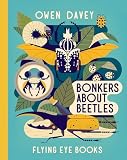
Bonkers About Beetles
by Owen Davey
Reading Profile
Should I read this?
Bold, colorful illustrations and short, punchy fact captions make this a brisk, child-friendly primer on beetle diversity. The useful part is its visual variety — stylized plates that highlight size, color, and quirky traits so young readers notice differences. Limitation: text is shallow by design, often a sentence or two per species, so adults seeking field-guide accuracy or deeper ecology will be frustrated. Best consumed aloud, browsed in short sittings, or used as a visual starter for hands-on nature activities rather than a detailed reference.
Read this if...
- •primary-school teacher planning a two-week insect unit who needs vivid images and short facts to spark classroom discussion and quick ID activities.
- •parent of a curious 4–8-year-old who wants a read-aloud picture book to point out shapes, colors, and strange beetle facts during walks or before bed.
- •children's librarian or museum educator assembling a hands-on table who needs a nontechnical, high-appeal book kids can flip through and browse independently.
Skip this if...
- •You’ll likely put it down when you were expecting a field guide with range maps, keys, or rigorous identification detail—the text is too brief for serious ID work.
- •Annoying if you prefer photographs and strict realism: the stylized art simplifies anatomy and color for visual effect rather than exact replication.
- •Lose interest if you wanted narrative-driven essays or long-form natural history; the book repeats short, caption-style entries and can feel episodic and shallow.
Did you know that there are roughly 400,000 different species of beetles These incredible creatures make up about 25% of all animals on our planet! Beetles are superbly adapted to life in various climates across the world, wherever trees and flowers are found. From the mighty Goliath beetle to the beautiful iridescent scarab beetle, this captivati...
Before You Buy
Reading Specifications
Difficulty:hard
Audience Fit
- primary-school teacher planning a two-week insect unit who needs vivid images and short facts to spark classroom discussion and quick ID activities.
- parent of a curious 4–8-year-old who wants a read-aloud picture book to point out shapes, colors, and strange beetle facts during walks or before bed.
- children's librarian or museum educator assembling a hands-on table who needs a nontechnical, high-appeal book kids can flip through and browse independently.
- You’ll likely put it down when you were expecting a field guide with range maps, keys, or rigorous identification detail—the text is too brief for serious ID work.
- Annoying if you prefer photographs and strict realism: the stylized art simplifies anatomy and color for visual effect rather than exact replication.
- Lose interest if you wanted narrative-driven essays or long-form natural history; the book repeats short, caption-style entries and can feel episodic and shallow.
Check formats, pricing, and availability options for Kindle, physical print, or audiobooks directly.
View available editions on AmazonKey themes
Why recommended
appears in Nature, Fiction, and Nonfiction.
Recommendation Signals
Recommendation proof is sourced from public posts, interviews, reading lists, and cited references.
No verified recommendation proof available yet.
Appears In
Not sure if this is the right fit?
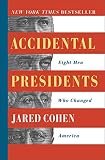
Consider Accidental Presidents by Jared Cohen. Recommended by 10 sources.
“Accidental Presidents offers eight narrative portraits of men who succeeded to the U.S. presidency without election, using anecdote-rich scenes and readable context to show how personality and circumstance interact with office power. It’s strongest as a set of self-contained stories that make succession stakes concrete for non-specialist readers; it does not prioritize dense archival argument or exhaustive methodology, so expect some interpretive generalizations and repeated themes across cases. Use it for fast historical orientation rather than scholarly deep-dives.”
Similar books

How recommendation signals are reviewed
Each recommendation is collected from a public source — interviews, articles, or curated lists — and linked to its original URL. Books with many verifiable recommendations from respected people rank higher.