
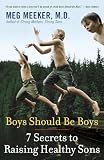
Boys Should Be Boys
7 Secrets to Raising Healthy Sons
by Meg Meeker
Reading Profile
Should I read this?
Meg Meeker writes directly to Christian parents who worry today's culture softens boyhood, offering anecdote-rich chapters that press for unstructured play, roughhousing, and clear limits. it can feel conversational and sermon-like: lots of personal stories, practical tips, and exhortation rather than academic sourcing. Useful when you want clear language to push back against over-scheduling and screen dependence. Limiting when you expect nuance about gender diversity, modern safety limitations, or empirical citations—readers seeking research-heavy analysis or hands-on exercises will likely be disappointed.
Read this if...
- •a Christian mother of elementary-age boys who feels pressure to keep them constantly scheduled and wants faith-based, plainspoken arguments for free play and boundaries
- •a father of a preteen trying to reduce screen time and encourage more physical play who needs concrete, values-rooted talking points to share with family
- •a church youth leader preparing a brief talk on boyhood who wants anecdotal, faith-aligned material to illustrate why roughhousing and responsibility matter
Skip this if...
- •you'll likely put it down when chapters shift into repeated moralizing and the same anecdotes and prescriptions keep returning without new evidence or nuance
- •annoying if you prefer gender-neutral parenting advice or careful discussion of gender identity and diversity—this book assumes traditional boy/girl roles
- •friction for readers seeking academic sourcing, step-by-step exercises, or balanced risk assessments—it offers exhortation and stories, not systematic research or hands-on curricula
In Boys Should Be Boys, one of our most trusted authorities helps parents restore the delights of boyhood and enable today?s boys to become the mature, confident, and thoughtful men of tomorrow. Boys will always be boys?rambunctious, adventurous, and curious, climbing trees, building forts, playing tackle football, and pushing their growing bodies ...
Before You Buy
Reading Specifications
Difficulty:hard
Audience Fit
- a Christian mother of elementary-age boys who feels pressure to keep them constantly scheduled and wants faith-based, plainspoken arguments for free play and boundaries
- a father of a preteen trying to reduce screen time and encourage more physical play who needs concrete, values-rooted talking points to share with family
- a church youth leader preparing a brief talk on boyhood who wants anecdotal, faith-aligned material to illustrate why roughhousing and responsibility matter
- you'll likely put it down when chapters shift into repeated moralizing and the same anecdotes and prescriptions keep returning without new evidence or nuance
- annoying if you prefer gender-neutral parenting advice or careful discussion of gender identity and diversity—this book assumes traditional boy/girl roles
- friction for readers seeking academic sourcing, step-by-step exercises, or balanced risk assessments—it offers exhortation and stories, not systematic research or hands-on curricula
Check formats, pricing, and availability options for Kindle, physical print, or audiobooks directly.
View available editions on AmazonKey themes
Why recommended
appears in Christian Parenting, Parenting, and Nonfiction.
Recommendation Signals
Recommendation proof is sourced from public posts, interviews, reading lists, and cited references.
No verified recommendation proof available yet.
Appears In
Not sure if this is the right fit?
Consider Give Them Grace by Elyse M. Fitzpatrick.
“Reads like a pastoral primer that pushes parents to rethink 'being good' as a response to grace rather than a set of rules to earn approval. Strength lies in its clear theological language, scriptural examples, and concrete parenting scenarios that model gospel-centered responses. Limitation: sustained doctrinal argument and repeated proof-texting can become preachy and repetitive, and there are few step-by-step behavior strategies or secular psychological tools for parents who want practical how-tos.”
Similar books
How recommendation signals are reviewed
Each recommendation is collected from a public source — interviews, articles, or curated lists — and linked to its original URL. Books with many verifiable recommendations from respected people rank higher.