
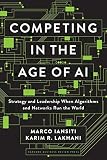
Competing in the Age of AI
Strategy and Leadership When Algorithms and Networks Run the World
by Marco Iansiti
Reading Profile
Should I read this?
Competing in the Age of AI lays out how data and AI change firm boundaries and operating logic, trading technical detail for managerial analysis and corporate examples. Reading feels like a series of executive briefings: chapters provide vocabulary and limitations useful when arguing reorganizations, governance choices, and platform economics. The most usable sections are the firm-level reasoning and the case comparisons that show where AI alters processes, decision rights, and scale. Friction sets in when long managerial analyses repeat similar lessons without concrete operational steps. It offers little engineering-level how-to.
Read this if...
- •a CTO at a mid-size incumbent deciding whether to centralize data teams — gives organizational trade-offs and language to argue restructuring to skeptical executives
- •a strategy consultant preparing a transformation proposal for a legacy-industry client — provides case-based points and firm-level reasoning to shape investment priorities and governance choices
- •a founder selling AI tools to large enterprises — helps frame where a product fits into changing operating models and where buyers will need governance or scale changes
Skip this if...
- •you'll likely put it down when long sections dig into management design and repeated corporate examples — impatient readers often drop off here
- •annoying if you prefer engineering playbooks, code, or short tactical how-tos — the book stays at firm-level strategy rather than step-by-step implementation
- •lose interest if you wanted narrative-driven storytelling or light tech writing — the tone is strategy-heavy and example-rich rather than story-first
In industry after industry, data, analytics, and AIdriven processes are transforming the nature of work. While we often still treat AI as the domain of a specific skill, business function, or sector, we have entered a new era in which AI is challenging the very concept of the firm. AIcentric organizations exhibit a new operating Architecture,, red...
Before You Buy
Reading Specifications
Difficulty:hard
Audience Fit
- a CTO at a mid-size incumbent deciding whether to centralize data teams — gives organizational trade-offs and language to argue restructuring to skeptical executives
- a strategy consultant preparing a transformation proposal for a legacy-industry client — provides case-based points and firm-level reasoning to shape investment priorities and governance choices
- a founder selling AI tools to large enterprises — helps frame where a product fits into changing operating models and where buyers will need governance or scale changes
- you'll likely put it down when long sections dig into management design and repeated corporate examples — impatient readers often drop off here
- annoying if you prefer engineering playbooks, code, or short tactical how-tos — the book stays at firm-level strategy rather than step-by-step implementation
- lose interest if you wanted narrative-driven storytelling or light tech writing — the tone is strategy-heavy and example-rich rather than story-first
Check formats, pricing, and availability options for Kindle, physical print, or audiobooks directly.
View available editions on AmazonKey themes
Why recommended
Recommended by 2 sources and appears in Strategic Thinking, Most Recommended Books, and Management.
Recommendation Signals
Recommendation proof is sourced from public posts, interviews, reading lists, and cited references.
No verified recommendation proof available yet.
Appears In
Not sure if this is the right fit?
Consider AI Superpowers by Kaifu Lee. Recommended by 20 sources.
“This book reads like a well-connected technologist’s urgent TED talk, blending personal career story, startup anecdotes, and macro predictions. What works best is a clear, alarm-bell view of China’s rapid AI rise and the coming job displacement, with tangible data and sector breakdowns. You’ll likely find it useful as a conversation starter or trend snapshot. But it often oversimplifies complex geopolitical and ethical tensions into a binary rivalry, and the determined optimism can feel boosterish. The tone may grate if you prefer nuanced, academic treatments or worry about the author’s business interests shaping the narrative.”
Similar books
AI Superpowers
Kaifu Lee
Python Machine Learning
Sebastian Raschka
A Guide to the Project Management Body of Knowledge
Project Management Institute
Human Compatible
Stuart Russell
Powerful
Patty McCord
My Years with General Motors
Alfred Sloan
Execution
Larry Bossidy
The First 90 Days
Michael D. WatkinsHow recommendation signals are reviewed
Each recommendation is collected from a public source — interviews, articles, or curated lists — and linked to its original URL. Books with many verifiable recommendations from respected people rank higher.