
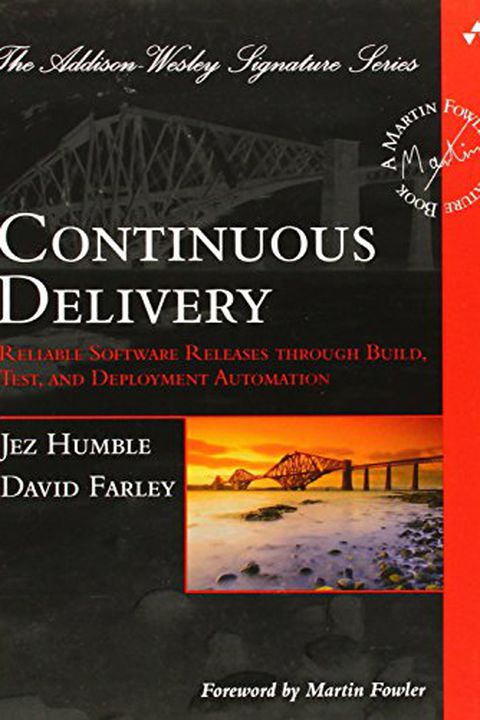
Continuous Delivery
Reliable Software Releases through Build, Test, and Deployment Automation (AddisonWesley Signature Series (Fowler))
by Jez Humble
Reading Profile
Should I read this?
Continuous Delivery reads like a practitioner's manual for making software releases faster and safer, heavy on process recipes, pipeline patterns, and automation practices. Its most useful sections give concrete steps for automating build, test, and deployment flows so teams can ship smaller, more frequent changes with lower risk. The tone is prescriptive and detail-oriented, which helps during implementation but frustrates readers expecting high-level case studies or light narrative. Implementation detail can feel tedious if you're not working on CI/CD right away.
Read this if...
- •Senior backend engineer at a startup responsible for building CI/CD pipelines from scratch — offers pipeline patterns, test automation approaches, and deployment tactics you can begin implementing this quarter.
- •Engineering manager inside a legacy enterprise trying to increase release cadence without frequent incidents — helps identify handoff reductions, automated checks, and deployment strategies to lower release risk.
- •Site reliability or DevOps engineer migrating a monolith to automated pipelines — contains concrete practices for build automation, environment provisioning, and incremental rollout techniques useful during migration.
Skip this if...
- •You'll likely put it down when chapters deep-dive into configuration examples, tool-specific pipeline scripts, and long implementation details if you expected a high-level narrative or business-case examples.
- •Annoying if you prefer non-technical prose, storytelling, or lightweight reads — the tone stays prescriptive and process-heavy rather than anecdotal.
- •No hands-on exercises — lacks guided labs or step-by-step tutorials, so it frustrates readers who wanted interactive practice rather than a reference-style guide.
Winner of the 2011 Jolt Excellence Award!Getting software released to users is often a painful, risky, and timeconsuming process. This groundbreaking new book sets out the principles and technical practices that enable rapid, incremental delivery of high quality, valuable new functionality to users. Through automation of the build, deployment, and...
Before You Buy
Reading Specifications
Difficulty:hard
Audience Fit
- Senior backend engineer at a startup responsible for building CI/CD pipelines from scratch — offers pipeline patterns, test automation approaches, and deployment tactics you can begin implementing this quarter.
- Engineering manager inside a legacy enterprise trying to increase release cadence without frequent incidents — helps identify handoff reductions, automated checks, and deployment strategies to lower release risk.
- Site reliability or DevOps engineer migrating a monolith to automated pipelines — contains concrete practices for build automation, environment provisioning, and incremental rollout techniques useful during migration.
- You'll likely put it down when chapters deep-dive into configuration examples, tool-specific pipeline scripts, and long implementation details if you expected a high-level narrative or business-case examples.
- Annoying if you prefer non-technical prose, storytelling, or lightweight reads — the tone stays prescriptive and process-heavy rather than anecdotal.
- No hands-on exercises — lacks guided labs or step-by-step tutorials, so it frustrates readers who wanted interactive practice rather than a reference-style guide.
Check formats, pricing, and availability options for Kindle, physical print, or audiobooks directly.
View available editions on AmazonKey themes
Why recommended
appears in Devops, For Devops, and Programming.
Recommendation Signals
Recommendation proof is sourced from public posts, interviews, reading lists, and cited references.
No verified recommendation proof available yet.
Appears In
Not sure if this is the right fit?
Consider Accidental Presidents by Jared Cohen. Recommended by 10 sources.
“Accidental Presidents offers eight narrative portraits of men who succeeded to the U.S. presidency without election, using anecdote-rich scenes and readable context to show how personality and circumstance interact with office power. It’s strongest as a set of self-contained stories that make succession stakes concrete for non-specialist readers; it does not prioritize dense archival argument or exhaustive methodology, so expect some interpretive generalizations and repeated themes across cases. Use it for fast historical orientation rather than scholarly deep-dives.”
Similar books


How recommendation signals are reviewed
Each recommendation is collected from a public source — interviews, articles, or curated lists — and linked to its original URL. Books with many verifiable recommendations from respected people rank higher.