
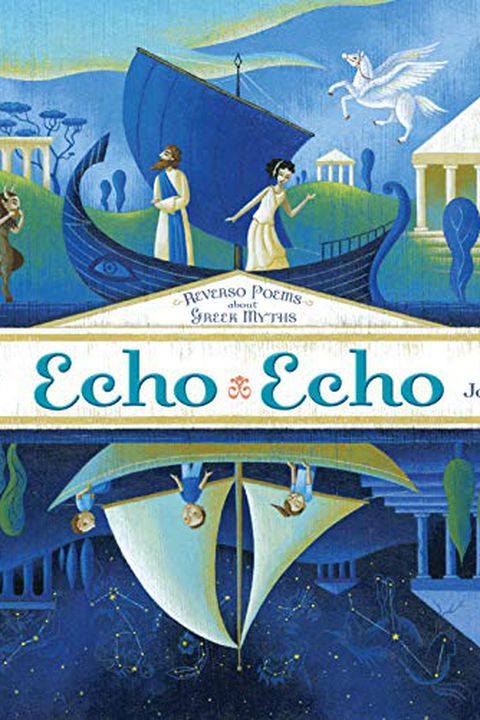
Echo Echo
Reverso Poems About Greek Myths
by Marilyn Singer
Reading Profile
Should I read this?
Echo Echo is a compact, inventive collection of reverso poems by Marilyn Singer that retells bits of Greek mythology by turning lines into mirrored counterparts. it reads as playful and performative: many poems reward being read aloud because small changes in line order shift tone and perspective. What works best is the formal game—two-sided poems that invite comparison and close reading. The main limitation is that the constraint of the reverso form keeps every piece brief; readers seeking full narratives or deep character development may find the poems clever but thin.
Read this if...
- •elementary-school teacher preparing a 45-minute unit on myths who needs short, performable texts to contrast perspective and voice — poems work well for read-aloud demos and quick classroom discussion.
- •parent of a 6–10-year-old looking for bedtime reads that surprise — each poem is short, playful, and invites the child to notice how small changes alter meaning.
- •children's librarian planning a 20–30 minute storytime who wants interactive material — the mirrored structure becomes a little performance trick that gets kids listening and guessing.
Skip this if...
- •You’ll likely put it down when you expect continuous storytelling; the reverso format fragments myths into tiny mirrored snapshots rather than unfolding plots.
- •Annoying if you prefer prose or long-form retellings; poems are brief and rely on formal trickery instead of character development or scene-building.
- •Annoying if you want hands-on exercises or explicit teaching guides — the book offers poems, not lesson plans or step-by-step activities; repetition of the mirror device can also feel gimmicky after a few pieces.
A new book of unique reversible poems based on Greek myths from the creator of Mirror Mirror What happens when you hold up a mirror to poems about Greek myths You get a brandnew perspective on the classics! And that is just what happens in Echo Echo, the newest collection of reverso poems from Marilyn Singer. Read one way, each poem tells the...
Before You Buy
Reading Specifications
Difficulty:hard
Audience Fit
- elementary-school teacher preparing a 45-minute unit on myths who needs short, performable texts to contrast perspective and voice — poems work well for read-aloud demos and quick classroom discussion.
- parent of a 6–10-year-old looking for bedtime reads that surprise — each poem is short, playful, and invites the child to notice how small changes alter meaning.
- children's librarian planning a 20–30 minute storytime who wants interactive material — the mirrored structure becomes a little performance trick that gets kids listening and guessing.
- You’ll likely put it down when you expect continuous storytelling; the reverso format fragments myths into tiny mirrored snapshots rather than unfolding plots.
- Annoying if you prefer prose or long-form retellings; poems are brief and rely on formal trickery instead of character development or scene-building.
- Annoying if you want hands-on exercises or explicit teaching guides — the book offers poems, not lesson plans or step-by-step activities; repetition of the mirror device can also feel gimmicky after a few pieces.
Check formats, pricing, and availability options for Kindle, physical print, or audiobooks directly.
View available editions on AmazonKey themes
Why recommended
appears in Poetry, Poetry, and Fiction.
Recommendation Signals
Recommendation proof is sourced from public posts, interviews, reading lists, and cited references.
No verified recommendation proof available yet.
Appears In
Not sure if this is the right fit?
Consider The Republic by Plato. Recommended by 13 sources.
“Plato stages an extended Socratic conversation that moves from concrete questions about justice into broad proposals about an ideal city, the structure of the soul, and what counts as reality and knowledge. Reading alternates brisk question-and-answer snippets with long, cumulative demonstrations that reward careful attention and annotation. Main value: a wealth of thought experiments for testing political and ethical intuitions. Main limitation: repetitive refutations, long policy sketches and dense metaphysical passages can feel abstruse and slow; patience and some philosophical background help.”
Similar books

How recommendation signals are reviewed
Each recommendation is collected from a public source — interviews, articles, or curated lists — and linked to its original URL. Books with many verifiable recommendations from respected people rank higher.