
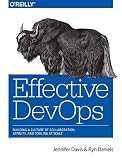
Effective DevOps
Building a Culture of Collaboration, Affinity, and Tooling at Scale
by Jennifer Davis
Reading Profile
Should I read this?
Reading this feels like a practitioner’s field guide: hands-on, case-driven chapters that alternate failure stories with concrete tactics for implementing and maintaining DevOps. What works best is pragmatic advice that connects cultural shifts, managerial decisions, and engineering practices so teams can try small, sustainable changes. The main limitation is a reliance on anecdote and managerial perspective—some chapters rehash similar points—and the book rarely includes step-by-step scripts or CLI-level tutorials. Best used as a tactical playbook to spark experiments rather than a how-to checklist.
Read this if...
- •Mid-level site reliability engineer at a midsize company trying to reduce deployment pain: offers real-world examples and language you can use to coordinate with product and ops and propose incremental pipeline changes.
- •Engineering manager in a legacy enterprise pushing for continuous delivery: useful when you need case studies and managerial strategies to win leadership buy-in and measure small, safe wins.
- •Tech lead joining a team expected to adopt DevOps practices: helps pick manageable first moves, avoid common cultural missteps, and frame experiments that prove value quickly.
Skip this if...
- •You’ll likely put it down when chapters replay similar anecdotes without delivering CLI commands or deploy scripts—if you wanted immediate, copy-paste technical recipes, this isn’t that book.
- •Annoying if you prefer deeply technical, tool-focused how-to guides: the emphasis is on organizational change and collaboration more than configuration or code.
- •Lose interest if you want rigorous academic theory or tightly argued models; readers who expect a tightly structured methodology may find the prose conversational and example-heavy.
This practical guide addresses technical, cultural, and managerial challenges of implementing and maintaining a DevOps culture by describing failures and successes. Authors Katherine Daniels and Jennifer Davis provide with actionable strategies you can use to engineer sustainable changes in your environment regardless of your level within your orga...
Before You Buy
Reading Specifications
Difficulty:easy
Audience Fit
- Mid-level site reliability engineer at a midsize company trying to reduce deployment pain: offers real-world examples and language you can use to coordinate with product and ops and propose incremental pipeline changes.
- Engineering manager in a legacy enterprise pushing for continuous delivery: useful when you need case studies and managerial strategies to win leadership buy-in and measure small, safe wins.
- Tech lead joining a team expected to adopt DevOps practices: helps pick manageable first moves, avoid common cultural missteps, and frame experiments that prove value quickly.
- You’ll likely put it down when chapters replay similar anecdotes without delivering CLI commands or deploy scripts—if you wanted immediate, copy-paste technical recipes, this isn’t that book.
- Annoying if you prefer deeply technical, tool-focused how-to guides: the emphasis is on organizational change and collaboration more than configuration or code.
- Lose interest if you want rigorous academic theory or tightly argued models; readers who expect a tightly structured methodology may find the prose conversational and example-heavy.
Check formats, pricing, and availability options for Kindle, physical print, or audiobooks directly.
View available editions on AmazonKey themes
Why recommended
appears in Devops, For Devops, and Programming.
Recommendation Signals
Recommendation proof is sourced from public posts, interviews, reading lists, and cited references.
No verified recommendation proof available yet.
Appears In

Not sure if this is the right fit?
Consider Accidental Presidents by Jared Cohen. Recommended by 10 sources.
“Accidental Presidents offers eight narrative portraits of men who succeeded to the U.S. presidency without election, using anecdote-rich scenes and readable context to show how personality and circumstance interact with office power. It’s strongest as a set of self-contained stories that make succession stakes concrete for non-specialist readers; it does not prioritize dense archival argument or exhaustive methodology, so expect some interpretive generalizations and repeated themes across cases. Use it for fast historical orientation rather than scholarly deep-dives.”
Similar books



How recommendation signals are reviewed
Each recommendation is collected from a public source — interviews, articles, or curated lists — and linked to its original URL. Books with many verifiable recommendations from respected people rank higher.