
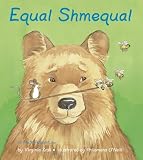
Equal Shmequal
by Virginia Kroll
Reading Profile
Should I read this?
Equal Shmequal is a compact picture-book read-aloud that uses a tug-of-war problem and an animal cast to make the notion of 'equal' tangible for young listeners. The writing is straightforward and the illustrations are called out as lively, so the book works well as a prompt for counting or a brief classroom talk. Its main limitation is a slightly didactic teaching beat: adults seeking interactive follow-ups or nonstop action may find the middle section feels instructional and interrupts the play.
Read this if...
- •Preschool teacher planning a 10-minute math storytime: provides a single, concrete scenario to prompt counting and a quick group discussion.
- •Parent reading at bedtime to a 3–6 year old curious about fairness: short animal characters and a neat resolution make the abstract idea of equality accessible without a long setup.
- •Children's librarian assembling an early-math display or circle time: bright illustrations and a tidy problem-solution arc slot easily into a themed session.
Skip this if...
- •You’ll likely put it down when the story pauses for the extended math explanation — if your child needs constant action or rhythmic text, the middle section can feel slow.
- •Annoying if you prefer books that include interactive activities or games — the book lacks hands-on exercises or follow-up play suggestions.
- •Not for readers seeking deep moral nuance or layered storytelling; the conclusion is tidy and may come across as overly instructional rather than open-ended.
What does it mean to be equal Mouse and her friends want to play tugofwar but they can't figure out how to make teams that are equal. Nothing works until Mouse starts thinking mathematically. Wonderful illustrations capture Mouse and her animal friends from whiskers to tails....
Before You Buy
Reading Specifications
Difficulty:easy
Audience Fit
- Preschool teacher planning a 10-minute math storytime: provides a single, concrete scenario to prompt counting and a quick group discussion.
- Parent reading at bedtime to a 3–6 year old curious about fairness: short animal characters and a neat resolution make the abstract idea of equality accessible without a long setup.
- Children's librarian assembling an early-math display or circle time: bright illustrations and a tidy problem-solution arc slot easily into a themed session.
- You’ll likely put it down when the story pauses for the extended math explanation — if your child needs constant action or rhythmic text, the middle section can feel slow.
- Annoying if you prefer books that include interactive activities or games — the book lacks hands-on exercises or follow-up play suggestions.
- Not for readers seeking deep moral nuance or layered storytelling; the conclusion is tidy and may come across as overly instructional rather than open-ended.
Check formats, pricing, and availability options for Kindle, physical print, or audiobooks directly.
View available editions on AmazonKey themes
Why recommended
appears in Math and Fiction.
Recommendation Signals
Recommendation proof is sourced from public posts, interviews, reading lists, and cited references.
No verified recommendation proof available yet.
Appears In
Not sure if this is the right fit?
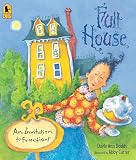
Consider Full House by Dayle Ann Dodds.
“Full House by Dayle Ann Dodds is a bright, sing-song picture book set in the Strawberry Inn where guests arrive until every room is full; the rhyming text and busy, whimsical art make it an easy read-aloud that nudges toward simple fraction ideas through counting and sharing. Its useful part is creating a playful, memorable frame for introducing halves and quarters without heavy exposition. Limitation: math remains implicit and adults looking for precise teaching language or practice prompts will find it thin.”
Similar books
Full House
Dayle Ann Dodds
Elementary and Middle School Mathematics
John A. van de Walle
Sir Cumference and All the King's Tens
Cindy Neuschwander
Pigs Will Be Pigs
Amy Axelrod
The CauchySchwarz Master Class
J. Michael Steele
Anno's Mysterious Multiplying Jar
Masaichiro Anno
Divide and Ride
Stuart J. Murphy
Math Curse
Jon ScieszkaHow recommendation signals are reviewed
Each recommendation is collected from a public source — interviews, articles, or curated lists — and linked to its original URL. Books with many verifiable recommendations from respected people rank higher.