
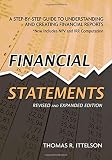
Financial Statements
A StepbyStep Guide to Understanding and Creating Financial Reports
by Thomas Ittelson
Reading Profile
Should I read this?
Financial Statements is a patient, diagram-heavy primer that teaches nonfinancial managers how to read the three core reports and see how they connect. Chapters keep language simple and lean on annotated examples so the logic behind profit, cash and assets feels tangible rather than abstract. What works best is practical literacy: enough to ask sensible questions and spot basic issues. Limitation: it stops short of advanced accounting nuance and can feel repetitive for readers with prior bookkeeping experience.
Read this if...
- •marketing director at a mid-size company preparing quarterly reviews — needs to read balance sheets and cash-flow signals to justify budget requests and explain numbers to leadership.
- •small-business owner reworking pricing and runway forecasts — wants to understand the difference between profit, cash and retained earnings without learning debits and credits in depth.
- •product manager involved in a finance-heavy acquisition integration — needs to spot obvious red flags on target statements before handing work to accounting specialists.
Skip this if...
- •you'll likely put it down when the book spends several pages on detailed, repetitive line-item mechanics and numerical walkthroughs — that mid-book grind loses readers who wanted a quick practical overview.
- •annoying if you prefer formal accounting rules or audit-level detail; the book favors plain explanation over technical standards and recognition criteria.
- •annoying if you want hands-on modelling or exercises: better as an explanatory primer than an exercise-driven how-to for building spreadsheets.
Now the bestselling book of its kind has gotten even better.This revised and expanded second edition of Ittelson's master work will give you that firm grasp of "the numbers" necessary for business success. With more than 100,000 copies in print, Financial Statements is a perfect introduction to financial accounting for nonfinancial managers, stoc...
Before You Buy
Reading Specifications
Difficulty:hard
Audience Fit
- marketing director at a mid-size company preparing quarterly reviews — needs to read balance sheets and cash-flow signals to justify budget requests and explain numbers to leadership.
- small-business owner reworking pricing and runway forecasts — wants to understand the difference between profit, cash and retained earnings without learning debits and credits in depth.
- product manager involved in a finance-heavy acquisition integration — needs to spot obvious red flags on target statements before handing work to accounting specialists.
- you'll likely put it down when the book spends several pages on detailed, repetitive line-item mechanics and numerical walkthroughs — that mid-book grind loses readers who wanted a quick practical overview.
- annoying if you prefer formal accounting rules or audit-level detail; the book favors plain explanation over technical standards and recognition criteria.
- annoying if you want hands-on modelling or exercises: better as an explanatory primer than an exercise-driven how-to for building spreadsheets.
Check formats, pricing, and availability options for Kindle, physical print, or audiobooks directly.
View available editions on AmazonKey themes
Why recommended
appears in Accounting, Finance, and Business.
Recommendation Signals
Recommendation proof is sourced from public posts, interviews, reading lists, and cited references.
No verified recommendation proof available yet.
Appears In
Not sure if this is the right fit?
Consider The Undoing Project by Michael Lewis. Recommended by 18 sources.
“Michael Lewis chronicles the friendship and intellectual partnership of Daniel Kahneman and Amos Tversky, who championed the idea that cognitive biases shape our choices. The narrative reads like a buddy story, weaving their discoveries into personal anecdotes and the drama of their collaboration. You'll grasp key ideas—loss aversion, framing—through their story, but the book focuses on biography, not application. Helpful for understanding behavioral economics' origins; less useful if you want actionable advice. The emotional arc of their relationship can overshadow the science.”
Similar books
The Undoing Project
Michael Lewis
The Little Book of Common Sense Investing
John C. Bogle
Financial Shenanigans
Howard Schilit
Scale
Geoffrey West
Poor Numbers
Morten Jerven
The Great Illusion
Norman Angell
One Billion Americans
Matthew Yglesias
Accounting Principles Standalone book
Jerry J. WeygandtHow recommendation signals are reviewed
Each recommendation is collected from a public source — interviews, articles, or curated lists — and linked to its original URL. Books with many verifiable recommendations from respected people rank higher.