
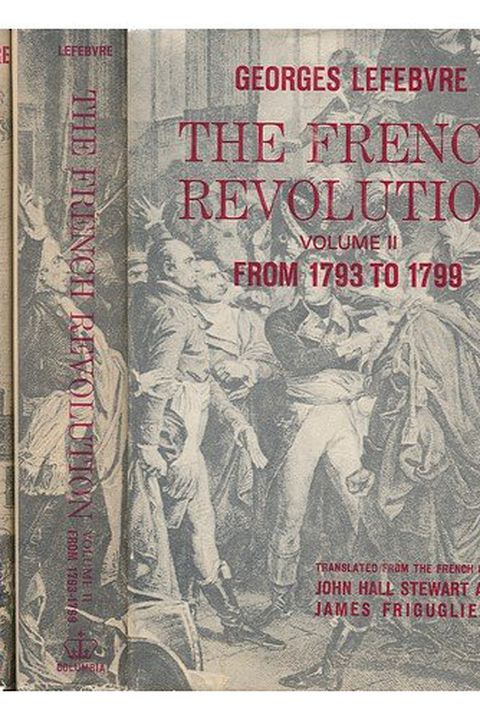
French Revolution from Its Origins to 1793
by Georges Lefebvre
Reading Profile
Should I read this?
Readable but scholarly narrative that walks through political events, social pressures, and regional variations from origins to 1793. What works best is a sustained, panoramic telling that ties street-level unrest to parliamentary maneuvering, useful for building a timeline and causal sense. Limitation: parts read like old-school scholarly prose—long paragraphs of event-by-event detail and occasional theoretical assumptions—so the book drags for readers seeking lively anecdote or short takeaways. Lacks hands-on exercises or modern interpretive apparatus.
Read this if...
- •graduate history student preparing for a seminar on the French Revolution who needs a single narrative backbone to situate more specialized articles and primary sources.
- •high-school history teacher building a multi-week unit on late 18th-century France who wants dependable chronology and social-political context for lectures and timelines.
- •independent reader fascinated by how revolutions unfold who prefers a cause-and-effect, big-picture account rather than fiction-like human vignettes.
Skip this if...
- •You’ll likely put it down when long stretches move into administrative minutiae and repetitive, event-by-event chronology that feel like slogging through archives.
- •Annoying if you prefer punchy, modern prose or short takeaways — the tone is steady and academic rather than conversational or vivid-portraiture.
- •Avoid if you want a current historiographical survey: the interpretive language and assumptions can feel dated and the book does not foreground recent debates.
Internationally renowned as the greatest authority on the French Revolution, Georges Lefebvre combined impeccable scholarship with a lively writing style. His masterly overview of the history of the French Revolution has taken its rightful place as the definitive account. A vivid narrative of events in France and across Europe is combined with acut...
Before You Buy
Reading Specifications
Difficulty:easy
Audience Fit
- graduate history student preparing for a seminar on the French Revolution who needs a single narrative backbone to situate more specialized articles and primary sources.
- high-school history teacher building a multi-week unit on late 18th-century France who wants dependable chronology and social-political context for lectures and timelines.
- independent reader fascinated by how revolutions unfold who prefers a cause-and-effect, big-picture account rather than fiction-like human vignettes.
- You’ll likely put it down when long stretches move into administrative minutiae and repetitive, event-by-event chronology that feel like slogging through archives.
- Annoying if you prefer punchy, modern prose or short takeaways — the tone is steady and academic rather than conversational or vivid-portraiture.
- Avoid if you want a current historiographical survey: the interpretive language and assumptions can feel dated and the book does not foreground recent debates.
Check formats, pricing, and availability options for Kindle, physical print, or audiobooks directly.
View available editions on AmazonKey themes
Why recommended
appears in French Revolution, History, and Nonfiction.
Recommendation Signals
Recommendation proof is sourced from public posts, interviews, reading lists, and cited references.
No verified recommendation proof available yet.
Appears In

Not sure if this is the right fit?
Consider Accidental Presidents by Jared Cohen. Recommended by 10 sources.
“Accidental Presidents offers eight narrative portraits of men who succeeded to the U.S. presidency without election, using anecdote-rich scenes and readable context to show how personality and circumstance interact with office power. It’s strongest as a set of self-contained stories that make succession stakes concrete for non-specialist readers; it does not prioritize dense archival argument or exhaustive methodology, so expect some interpretive generalizations and repeated themes across cases. Use it for fast historical orientation rather than scholarly deep-dives.”
Similar books


How recommendation signals are reviewed
Each recommendation is collected from a public source — interviews, articles, or curated lists — and linked to its original URL. Books with many verifiable recommendations from respected people rank higher.