
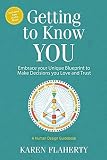
Getting to Know YOU
Embrace Your Unique Blueprint to Make Decisions you Love and Trust A Human Design Guidebook
by Karen Flaherty
Reading Profile
Should I read this?
Getting to Know YOU offers a friendly, conversational introduction to Human Design built from short type descriptions and everyday examples. Its most useful move is translating unfamiliar labels into plain-language situations you can try with family habits or small decisions. The book’s limit is repetition and an assumption that readers will accept energetic language without much interrogation; those wanting rigorous analysis or precise, repeatable procedures may find the material thin and the same points restated across chapters.
Read this if...
- •a parent managing two young children and frequent bedtime or chore battles who needs quick, shareable language to reduce friction — the book supplies short type labels you can introduce at tonight’s routine and test immediately
- •a product manager at a small startup prepping a sprint-planning meeting who wants low-effort conversation starters to reveal working rhythms — chapters provide bite-sized descriptions you can mention in the next team check-in without a big prep cost
- •an early-career professional juggling long hours and side projects who wants a skim-friendly way to experiment with personality shorthand between commitments — the book’s short sections let you try one or two labels during a commute or lunch break
Skip this if...
- •you prefer skeptical, analytic accounts — you'll likely put it down when type descriptions are presented as givens without deeper argument
- •annoying if you want step-by-step playbooks — repetitive, descriptive sections and few concrete tasks frustrate readers seeking exact procedures
- •you dislike spiritual or energetic language — the vocabulary and premises can feel fuzzy or prescriptive if you prefer secular, analytic explanations
Do you have trouble making choices sometimes Have you heard of Human Design It's a new personality assessment tool for helping you find easier ways to make decisions each and every day! And it's unique to you! Or are you looking for a new way to understand your energy and how you're wired To understand yourself And your family, fri...
Before You Buy
Reading Specifications
Difficulty:easy
Audience Fit
- a parent managing two young children and frequent bedtime or chore battles who needs quick, shareable language to reduce friction — the book supplies short type labels you can introduce at tonight’s routine and test immediately
- a product manager at a small startup prepping a sprint-planning meeting who wants low-effort conversation starters to reveal working rhythms — chapters provide bite-sized descriptions you can mention in the next team check-in without a big prep cost
- an early-career professional juggling long hours and side projects who wants a skim-friendly way to experiment with personality shorthand between commitments — the book’s short sections let you try one or two labels during a commute or lunch break
- you prefer skeptical, analytic accounts — you'll likely put it down when type descriptions are presented as givens without deeper argument
- annoying if you want step-by-step playbooks — repetitive, descriptive sections and few concrete tasks frustrate readers seeking exact procedures
- you dislike spiritual or energetic language — the vocabulary and premises can feel fuzzy or prescriptive if you prefer secular, analytic explanations
Check formats, pricing, and availability options for Kindle, physical print, or audiobooks directly.
View available editions on AmazonKey themes
Why recommended
appears in Human Design.
Recommendation Signals
Recommendation proof is sourced from public posts, interviews, reading lists, and cited references.
No verified recommendation proof available yet.
Appears In
Not sure if this is the right fit?
Consider Genetic Genealogy in Practice by Blaine T. Bettinger, Debbie Parker Wayne.
“A practical, task-oriented primer that flattens the learning curve for people starting with consumer DNA results. It’s strongest when you have test data in front of you and need concrete steps for interpreting matches, triangulating relationships, and converting leads into archival research. The text leans heavily on platform-specific walkthroughs and repeated procedure patterns, which can feel slow and tied to changing websites. If you want deep population-genetics background or a platform-agnostic theory, you'll find the coverage shallow.”
Similar books
Genetic Genealogy in Practice
Blaine T. Bettinger, Debbie Parker Wayne
DNA Q and A
Andrew Lee, Devon Noel Lee
Human Design Evolution Guide 2020
Karen Parker
Research Like a Pro
Diana Elder, Nicole Dyer
Trace Your Roots with DNA
Megan Smolenyak Smolenyak, Ann Turner
Human Design Activation Guide
Karen Curry Parker
Human Design
Ra Uru Hu, Lynda Bunnell
Finding Family
Richard HillHow recommendation signals are reviewed
Each recommendation is collected from a public source — interviews, articles, or curated lists — and linked to its original URL. Books with many verifiable recommendations from respected people rank higher.