
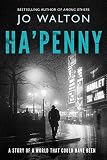
Ha'penny
A Story of a World that Could Have Been (Small Change (2))
by Jo Walton
Reading Profile
Should I read this?
Ha'penny reads like a quiet, morally sharp alternate-history focused on ordinary lives inside a Britain that made peace with Nazi Germany. Its value is the sustained attention to small compromises, social rituals, and the way everyday choices normalize political harm; the mystery element is driven by interviews, gossip, and procedural legwork rather than car chases. The main limitation is a deliberately talky, slow pace and repeated scenes of social maneuvering that will feel repetitive to readers wanting brisk plotting or obvious moral clarity.
Read this if...
- •a book-club leader preparing a meeting after a current-events prompt on complicity — needs short, debatable scenes to split across members; the novel's many domestic compromises and conversational standoffs provide ready discussion snippets and contrasting viewpoints.
- •a weekday commuter who reads in 30–45 minute stretches and prefers motive-driven mysteries — wants puzzles that advance by gossip, interviews and household detail rather than set-piece action; the book lets you make steady progress in short sittings while rewarding attention to small clues.
- •a graduate student or seminar instructor teaching counterfactuals or everyday collaboration under authoritarianism — needs close, scene-level material to analyze institutional and social adaptation; the novel supplies intimate portraits of institutions, manners, and household choices useful for class discussion or a paper.
Skip this if...
- •you'll likely put it down when the narrative lingers on repeated social scenes and conversational detail without new plot payoff — that midsection can feel static.
- •annoying if you prefer explicit moral verdicts or heroic protagonists; this novel trades certainty for ambiguity and social nuance.
- •lose interest if you wanted large-scale alternate geopolitics or lots of action; the focus is domestic, procedural, and atmospheric rather than cinematic.
Before Jo Walton won the Hugo and Nebula Awards for her stunning Among Others, she published a trilogy set in a dark alternate postwar England that had negotiated "Peace with Honor" with Nazi Germany in 1941. These novelsFarthing, Ha'penny, and Half a Crownare connected by common threads, but can be read in any order.In Ha'penny, England has comp...
Before You Buy
Reading Specifications
Difficulty:hard
Audience Fit
- a book-club leader preparing a meeting after a current-events prompt on complicity — needs short, debatable scenes to split across members; the novel's many domestic compromises and conversational standoffs provide ready discussion snippets and contrasting viewpoints.
- a weekday commuter who reads in 30–45 minute stretches and prefers motive-driven mysteries — wants puzzles that advance by gossip, interviews and household detail rather than set-piece action; the book lets you make steady progress in short sittings while rewarding attention to small clues.
- a graduate student or seminar instructor teaching counterfactuals or everyday collaboration under authoritarianism — needs close, scene-level material to analyze institutional and social adaptation; the novel supplies intimate portraits of institutions, manners, and household choices useful for class discussion or a paper.
- you'll likely put it down when the narrative lingers on repeated social scenes and conversational detail without new plot payoff — that midsection can feel static.
- annoying if you prefer explicit moral verdicts or heroic protagonists; this novel trades certainty for ambiguity and social nuance.
- lose interest if you wanted large-scale alternate geopolitics or lots of action; the focus is domestic, procedural, and atmospheric rather than cinematic.
Check formats, pricing, and availability options for Kindle, physical print, or audiobooks directly.
View available editions on AmazonKey themes
Why recommended
appears in Alternate History, Science Fiction, and Mystery & Crime.
Recommendation Signals
Recommendation proof is sourced from public posts, interviews, reading lists, and cited references.
No verified recommendation proof available yet.
Appears In
Not sure if this is the right fit?
Consider 11/22/63 by Stephen King. Recommended by 4 sources.
“Starts as a lean, suspenseful time-travel premise that quickly settles into an immersive, character-focused saga. Its chief useful part is the way everyday 1960s small-town life and personal relationships make the historical stakes feel immediate; the novel rewards readers who relish atmosphere and slow moral puzzles. The main limitation is length and digressions—long domestic passages and episodic subplots stretch the middle and can undercut urgency for readers who wanted a tighter thriller.”
Similar books
How recommendation signals are reviewed
Each recommendation is collected from a public source — interviews, articles, or curated lists — and linked to its original URL. Books with many verifiable recommendations from respected people rank higher.