
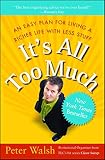
It's All Too Much
An Easy Plan for Living a Richer Life with Less Stuff
by Peter Walsh
Reading Profile
Should I read this?
It’s All Too Much delivers no-nonsense, room-by-room organizing advice sprinkled with personal anecdotes and emotional framing. Walsh's voice pushes readers toward decisive action—sorting, donating, and setting limits—so the practical takeaways are immediate and usable in an afternoon. What works best is in clear heuristics for everyday clutter and motivation to start; the main limitation is a tendency toward repetition and pep-talky language that flattens complex emotional reasons for hoarding. If you want deep psychology or systematic behavior-change models, this will feel thin.
Read this if...
- •a busy parent juggling toys, school papers, and limited time who needs fast, room-focused rules to reclaim living space; the book gives cut-to-the-chase steps you can apply between errands
- •someone preparing to downsize or move into a much smaller place who needs concrete decisions about what to keep and what to let go; the advice favors 'use it or lose it' choices that speed purging
- •a person stuck in decluttering procrastination who responds to direct, coach-like language and wants immediate, actionable tasks rather than theoretical explanations
Skip this if...
- •you'll likely put it down when the same anecdotes and motivational pep talks repeat across chapters; if you want varied case studies or tightly argued analysis, the repetition becomes grating
- •annoying if you prefer deep psychological nuance: emotional causes are treated in broad strokes rather than detailed patterns or clinical explanation
- •lose interest if you want a structured, incremental behavior-change program — the book offers practical tips and motivation but not a step-by-step course of exercises
Whether it?s tidying up or tinyhouse living, the decluttering revolution is taking America by storm. In It?s All Too Much organizational expert Peter Walsh reveals the tools for taking control of your physical?and emotional?clutter in order to reclaim your life.Are you surrounded by papers Overstuffed closets Are you stepping over toys or search...
Before You Buy
Reading Specifications
Difficulty:easy
Audience Fit
- a busy parent juggling toys, school papers, and limited time who needs fast, room-focused rules to reclaim living space; the book gives cut-to-the-chase steps you can apply between errands
- someone preparing to downsize or move into a much smaller place who needs concrete decisions about what to keep and what to let go; the advice favors 'use it or lose it' choices that speed purging
- a person stuck in decluttering procrastination who responds to direct, coach-like language and wants immediate, actionable tasks rather than theoretical explanations
- you'll likely put it down when the same anecdotes and motivational pep talks repeat across chapters; if you want varied case studies or tightly argued analysis, the repetition becomes grating
- annoying if you prefer deep psychological nuance: emotional causes are treated in broad strokes rather than detailed patterns or clinical explanation
- lose interest if you want a structured, incremental behavior-change program — the book offers practical tips and motivation but not a step-by-step course of exercises
Check formats, pricing, and availability options for Kindle, physical print, or audiobooks directly.
View available editions on AmazonKey themes
Why recommended
Recommended by 2 sources and appears in Minimalism, Most Recommended Books, and Personal Development.
Recommended by notable people
People and public figures who have recommended this book.
Recommendation Signals
Recommendation proof is sourced from public posts, interviews, reading lists, and cited references.
Kevin Kelly
“I actually gave it a whole page in my book 'Cool Tools' because I thought the message was so profound.”
Appears In
Not sure if this is the right fit?
Consider Accidental Presidents by Jared Cohen. Recommended by 10 sources.
“Accidental Presidents offers eight narrative portraits of men who succeeded to the U.S. presidency without election, using anecdote-rich scenes and readable context to show how personality and circumstance interact with office power. It’s strongest as a set of self-contained stories that make succession stakes concrete for non-specialist readers; it does not prioritize dense archival argument or exhaustive methodology, so expect some interpretive generalizations and repeated themes across cases. Use it for fast historical orientation rather than scholarly deep-dives.”
Similar books


How recommendation signals are reviewed
Each recommendation is collected from a public source — interviews, articles, or curated lists — and linked to its original URL. Books with many verifiable recommendations from respected people rank higher.