
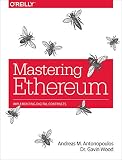
Mastering Ethereum
Building Smart Contracts and DApps
by Andreas M. Antonopoulos
1 more
More Recommenders
“#3: The Grid by Gretchen Bakke This is an older book but was an outstanding overview of how the American electrical grid works and how it’s evolving. #4: Mastering the Lightning Network by @aantonop This book is definitely for people that are running… | Mastering Ethereum, by Andreas Antonopolous and Gavin Wood, and Hands on Machine Learning with ScikitLearn & Tensorflow, by Aurélien Géron, are both masterpieces of technical exposition. In addition to helping me keep up with worldchanging Technology,, they remind me what a gift it is to be able to put down knowledge into an artifact – a book – and pass it so effectively to others. The clarity with these authors explain complex topics is a marvel. | These are books I found useful to learn about blockchain.”
Source →Recommended by 3 notable people, including Tim O’Reilly and Mark Russinovich
Check price on AmazonProof-backed recommendation
Amazon availability
Reading Profile
Should I read this?
Mastering Ethereum reads like a practical developer handbook that moves from conceptual overviews to line-by-line code and protocol internals. Expect clear runnable examples, deployment notes, and detailed explanations of transactions, gas, the EVM, and smart-contract behavior useful while building. The limitation is density: long technical passages assume programming experience and can feel granular or repetitive to a non-technical reader. Best used as a study reference during implementation rather than a quick introduction.
Read this if...
- •Backend developer at a startup integrating blockchain payments who needs runnable examples and low-level explanations to implement and debug smart-contract interactions quickly.
- •Product manager at a fintech company scoping a DApp proof-of-concept who must understand gas, deployment steps, and technical constraints to set realistic timelines and feature trade-offs.
- •Computer science student or hackathon builder converting a prototype into a deployed contract who wants concrete deployment instructions, code snippets, and troubleshooting notes while they build.
Skip this if...
- •You’ll likely put it down when the text dives into EVM bytecode, gas accounting, and low-level protocol math—those dense sections are a common drop-off point.
- •Annoying if you prefer narrative, policy, or history over code-heavy detail; the book prioritizes engineering specifics over storytelling and context.
- •Not a fit if you want guided classroom-style exercises or step-by-step practice sets — the book lacks dedicated hands-on exercise sections.
Ethereum represents the gateway to a worldwide, decentralized computing paradigm. This platform enables you to run decentralized applications (DApps) and smart contracts that have no central points of failure or control, integrate with a payment network, and operate on an open blockchain. With this practical guide, Andreas M. Antonopoulos and Gavin...
Before You Buy
Reading Specifications
Difficulty:medium
Audience Fit
- Backend developer at a startup integrating blockchain payments who needs runnable examples and low-level explanations to implement and debug smart-contract interactions quickly.
- Product manager at a fintech company scoping a DApp proof-of-concept who must understand gas, deployment steps, and technical constraints to set realistic timelines and feature trade-offs.
- Computer science student or hackathon builder converting a prototype into a deployed contract who wants concrete deployment instructions, code snippets, and troubleshooting notes while they build.
- You’ll likely put it down when the text dives into EVM bytecode, gas accounting, and low-level protocol math—those dense sections are a common drop-off point.
- Annoying if you prefer narrative, policy, or history over code-heavy detail; the book prioritizes engineering specifics over storytelling and context.
- Not a fit if you want guided classroom-style exercises or step-by-step practice sets — the book lacks dedicated hands-on exercise sections.
Check formats, pricing, and availability options for Kindle, physical print, or audiobooks directly.
View available editions on AmazonKey themes
Why recommended
Recommended by 3 sources and appears in Cryptocurrency.
Recommended by notable people
People and public figures who have recommended this book.
Recommendation Signals
Recommendation proof is sourced from public posts, interviews, reading lists, and cited references.
Preston Pysh
“#3: The Grid by Gretchen Bakke This is an older book but was an outstanding overview of how the American electrical grid works and how it’s evolving. #4: Mastering the Lightning Network by @aantonop This book is definitely for people that are running… | Mastering Ethereum, by Andreas Antonopolous and Gavin Wood, and Hands on Machine Learning with ScikitLearn & Tensorflow, by Aurélien Géron, are both masterpieces of technical exposition. In addition to helping me keep up with worldchanging Technology,, they remind me what a gift it is to be able to put down knowledge into an artifact – a book – and pass it so effectively to others. The clarity with these authors explain complex topics is a marvel. | These are books I found useful to learn about blockchain.”
View sources (3) ▾80%
Appears In

Not sure if this is the right fit?
Consider American Kingpin by Nick Bilton. Recommended by 12 sources.
“Nick Bilton writes a page-turning, reportorial account of Silk Road’s rise and fall, mixing newsroom detail with thriller pacing. Its useful part is the step-by-step reconstruction: setup, marketplace mechanics, the role of cryptocurrency, and the cat-and-mouse between operators and investigators. The limitation is episodic repetition—periods of breathless narrative alternate with long procedural or technical detours that pad runtime and undercut momentum. If you want scene-level reporting and dramatic chronology rather than deep legal or policy analysis, it delivers.”
Similar books
American Kingpin
Nick Bilton
The Bitcoin Standard
Saifedean Ammous
Bitcoin
Jason A. Williams
Cryptoassets
Chris Burniske
Attack of the 50 Foot Blockchain
David Gerard
Digital Gold
Nathaniel Popper
Bitcoin and Cryptocurrency Technologies
Arvind Narayanan
Mastering Bitcoin
Andreas M. AntonopoulosHow recommendation signals are reviewed
Each recommendation is collected from a public source — interviews, articles, or curated lists — and linked to its original URL. Books with many verifiable recommendations from respected people rank higher.