
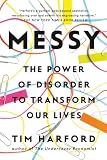
Messy
The Power of Disorder to Transform Our Lives
by Tim Harford
1 more
More Recommenders
Recommended by 3 notable people, including Adam Grant and Zoë Foster Blake
Check price on AmazonProof-backed recommendation
Amazon availability
Reading Profile
Should I read this?
Messy reads like a sequence of magazine-length case studies that argue disorganization and improvisation can yield creative advantages across business, politics and the arts. Its useful part is practical permission: vivid stories and metaphors you can use to justify experimentation and loosen rigid plans. Its main limitation is form—many chapters prioritize narrative over clear how-to, so readers looking for concrete, repeatable steps may find the book anecdote-heavy and occasionally repetitive.
Read this if...
- •a product manager at an early-stage startup trying to defend rapid iteration to cautious stakeholders — supplies memorable examples and language to argue for looser roadmaps now
- •an innovation lead inside a large company pushing pilot programs into conservative budgets — gives case studies and rhetorical tools to persuade risk-averse executives
- •a writer, designer, or creative professional stuck in perfectionism and stalled drafts — offers reassurance and stories that normalize messy, iterative work
Skip this if...
- •you’ll likely put it down when long anecdote sequences pile up without tidy takeaways — if you want a checklist or step-by-step manual, this’s not it
- •annoying if you prefer data-first or model-driven books — the emphasis is on stories and examples rather than formal methods
- •lose interest if you need tightly structured, fast-paced prose — chapters can feel loose and repetitive to readers who favor compact argumentation
'Ranging expertly across business, politics and the arts, Tim Harford makes a compelling case for the creative benefits of disorganization, improvisation and confusion. His liberating message: you'll be more successful if you stop struggling so hard to plan or control your success. Messy is a deeply researched, endlessly eyeopening adventure in th...
Before You Buy
Reading Specifications
Difficulty:hard
Audience Fit
- a product manager at an early-stage startup trying to defend rapid iteration to cautious stakeholders — supplies memorable examples and language to argue for looser roadmaps now
- an innovation lead inside a large company pushing pilot programs into conservative budgets — gives case studies and rhetorical tools to persuade risk-averse executives
- a writer, designer, or creative professional stuck in perfectionism and stalled drafts — offers reassurance and stories that normalize messy, iterative work
- you’ll likely put it down when long anecdote sequences pile up without tidy takeaways — if you want a checklist or step-by-step manual, this’s not it
- annoying if you prefer data-first or model-driven books — the emphasis is on stories and examples rather than formal methods
- lose interest if you need tightly structured, fast-paced prose — chapters can feel loose and repetitive to readers who favor compact argumentation
Check formats, pricing, and availability options for Kindle, physical print, or audiobooks directly.
View available editions on AmazonKey themes
Why recommended
Recommended by 4 sources and appears in Most Recommended Books, Finance, and Psychology.
Recommended by notable people
People and public figures who have recommended this book.
Recommendation Signals
Recommendation proof is sourced from public posts, interviews, reading lists, and cited references.

Adam Grant
Organizational psychologist; Wharton professor
“One of my favorite thinkers, Tim Harford, has a new fantastic book out:”
Appears In
Not sure if this is the right fit?
Consider The Boy, the Mole, the Fox and the Horse by Charlie Mackesy. Recommended by 8 sources.
“Soft-spoken, heavily illustrated fable built from short dialogues and watercolor sketches. Each spread pairs a spare line of text with a loose drawing, so the pleasure is visual and aphoristic rather than narrative; readers collect felt-true sentences more than plot. Most useful when you want quick consolations, a prompt for conversation with a child, or a pause during a rough day. Limiting if you want sustained argument, concrete advice, or tightly plotted storytelling: the repetition of gentleness can feel sentimental or thin after a while.”
Similar books
The Boy, the Mole, the Fox and the Horse
Charlie Mackesy
The World as It Is
Ben Rhodes
Out of Control
Kevin Kelly
The Bully Pulpit
Doris Kearns Goodwin
The Seven Spiritual Laws of Success
Deepak Chopra
Billions and Billions
Carl Sagan
Anger
Gary ChapmanFactfulness
Hans RoslingHow recommendation signals are reviewed
Each recommendation is collected from a public source — interviews, articles, or curated lists — and linked to its original URL. Books with many verifiable recommendations from respected people rank higher.