
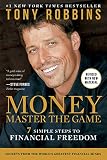
MONEY Master the Game
7 Simple Steps to Financial Freedom
by Tony Robbins
1 more
Recommended by 3 notable people, including Nat Eliason and Matt D_x0092_Avella
Check price on AmazonProof-backed recommendation
Amazon availability
Reading Profile
Should I read this?
Reading the book feels like sitting through an extended financial pep talk that periodically hands you concrete action items. Its useful part is energetic motivation blended with a broad set of practical suggestions aimed at helping readers organize priorities around saving, investing, and fees. Main limitation: the tone can be sermon-like and repetitive, and the length means useful advice is interleaved with long motivational detours. Not a compact manual—better picked through selectively than read straight through.
Read this if...
- •mid-career manager re-prioritizing retirement who needs a motivational nudge plus a broad set of tactics to organize savings and investment conversations with a financial adviser.
- •young professional starting to invest who wants big-picture roadmaps and encouragement to take concrete steps rather than dry technical spreadsheets.
- •small-business owner with irregular income who wants a mix of behavioral nudges and actionable suggestions to convert sporadic cash flow into longer-term financial planning.
Skip this if...
- •you'll likely put it down when long motivational passages repeat the same points and interrupt practical guidance — if you want concise, citation-heavy instruction, this will frustrate you.
- •annoying if you prefer a neutral, academic tone; the book leans toward coaching energy and confident directives rather than dry analysis.
- •avoid if you want step-by-step worksheets or a workbook format — lacks hands-on exercises and is not organized as a practice workbook.
Tony Robbins has coached and inspired more than 50 million people from over 100 countries. More than 4 million people have attended his live events. Oprah Winfrey calls him superhuman. Now for the first time in his first book in two decades he's turned to the topic that vexes us all: How to secure financial freedom for ourselves and our famili...
Before You Buy
Reading Specifications
Difficulty:hard
Audience Fit
- mid-career manager re-prioritizing retirement who needs a motivational nudge plus a broad set of tactics to organize savings and investment conversations with a financial adviser.
- young professional starting to invest who wants big-picture roadmaps and encouragement to take concrete steps rather than dry technical spreadsheets.
- small-business owner with irregular income who wants a mix of behavioral nudges and actionable suggestions to convert sporadic cash flow into longer-term financial planning.
- you'll likely put it down when long motivational passages repeat the same points and interrupt practical guidance — if you want concise, citation-heavy instruction, this will frustrate you.
- annoying if you prefer a neutral, academic tone; the book leans toward coaching energy and confident directives rather than dry analysis.
- avoid if you want step-by-step worksheets or a workbook format — lacks hands-on exercises and is not organized as a practice workbook.
Check formats, pricing, and availability options for Kindle, physical print, or audiobooks directly.
View available editions on AmazonKey themes
Why recommended
Recommended by 7 sources and appears in New Business, Finance, and Personal Finance.
Recommended by notable people
People and public figures who have recommended this book.
Recommendation Signals
Recommendation proof is sourced from public posts, interviews, reading lists, and cited references.
Appears In
Not sure if this is the right fit?
Consider The Undoing Project by Michael Lewis. Recommended by 18 sources.
“Michael Lewis chronicles the friendship and intellectual partnership of Daniel Kahneman and Amos Tversky, who championed the idea that cognitive biases shape our choices. The narrative reads like a buddy story, weaving their discoveries into personal anecdotes and the drama of their collaboration. You'll grasp key ideas—loss aversion, framing—through their story, but the book focuses on biography, not application. Helpful for understanding behavioral economics' origins; less useful if you want actionable advice. The emotional arc of their relationship can overshadow the science.”
Similar books
The Undoing Project
Michael Lewis
The Little Book of Common Sense Investing
John C. Bogle
Financial Shenanigans
Howard Schilit
Scale
Geoffrey West
Poor Numbers
Morten Jerven
The Great Illusion
Norman Angell
One Billion Americans
Matthew Yglesias
Accounting Principles Standalone book
Jerry J. WeygandtHow recommendation signals are reviewed
Each recommendation is collected from a public source — interviews, articles, or curated lists — and linked to its original URL. Books with many verifiable recommendations from respected people rank higher.