
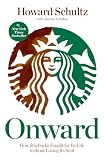
Onward
How Starbucks Fought for Its Life without Losing Its Soul
by Howard Schultz
Recommended by Tom Bilyeu and Ron Conway
Check price on AmazonProof-backed recommendation
Amazon availability
Reading Profile
Should I read this?
Onward is Howard Schultz’s first-person ledger of bringing Starbucks back from a downturn and refocusing the company on product, stores, and culture. It alternates store-floor anecdotes with boardroom scenes and sequential decision-making, so the most useful passages show concrete limitations about staffing, quality, and brand positioning. The narrative occasionally slides into defensive explanation and long stretches of operational minutiae that slow the pace. If you want crisp analytical models or a how-to handbook, this is lighter than that; read it for situational judgment and CEO-level vantage.
Read this if...
- •a regional retail operations manager rebuilding store standards after slipping KPIs — because the book offers detailed examples of staffing choices, training emphasis, and quality-control decisions at scale
- •a founder scaling a consumer-product startup into multiple cities — because it records supply, pricing, and local-store vs brand trade-offs faced during rapid expansion
- •a corporate strategy consultant preparing a client memo on turnaround options for a mature consumer brand — because the sequential, first-person account supplies concrete scenes for scenario planning and stakeholder dynamics
Skip this if...
- •you'll likely put it down when long stretches become timeline-heavy operational detail or defensive explanations — midbook operational minutiae is a common drop-off point
- •annoying if you prefer analytical, model-driven books or clear step-by-step playbooks — this memoir lacks systematic how-tos
- •annoying if you dislike CEO-centered perspective or a PR-friendly tone — expect confident justification of past choices rather than relentless self-critique
In this #1 New York Times bestseller, the CEO of Starbucks recounts the story and leadership lessons behind the global coffee company's comeback and continued success.In 2008, Howard Schultz decided to return as the CEO of Starbucks to help restore its financial health and bring the company back to its core values. In Onward, he shares this remarka...
Before You Buy
Reading Specifications
Difficulty:hard
Audience Fit
- a regional retail operations manager rebuilding store standards after slipping KPIs — because the book offers detailed examples of staffing choices, training emphasis, and quality-control decisions at scale
- a founder scaling a consumer-product startup into multiple cities — because it records supply, pricing, and local-store vs brand trade-offs faced during rapid expansion
- a corporate strategy consultant preparing a client memo on turnaround options for a mature consumer brand — because the sequential, first-person account supplies concrete scenes for scenario planning and stakeholder dynamics
- you'll likely put it down when long stretches become timeline-heavy operational detail or defensive explanations — midbook operational minutiae is a common drop-off point
- annoying if you prefer analytical, model-driven books or clear step-by-step playbooks — this memoir lacks systematic how-tos
- annoying if you dislike CEO-centered perspective or a PR-friendly tone — expect confident justification of past choices rather than relentless self-critique
Check formats, pricing, and availability options for Kindle, physical print, or audiobooks directly.
View available editions on AmazonKey themes
Why recommended
Recommended by 4 sources and appears in Coffee, Coffee, and Most Recommended Books.
Recommended by notable people
People and public figures who have recommended this book.
Recommendation Signals
Recommendation proof is sourced from public posts, interviews, reading lists, and cited references.
Tom Bilyeu
“Story of his return to Starbucks, and the success of the company in a tumlutuous economic time in history.”
Appears In
Not sure if this is the right fit?
Consider Good to Great by Jim Collins. Recommended by 32 sources.
“The book walks you through a multi-year research project, contrasting spectacular performers with mere survivors. The core insight—that sustained greatness hinges on disciplined people, thought, and action—feels sturdy and actionable. But the book’s arguments rely on retrospective selection of companies, and some of its darlings later faltered. You’ll find a methodical, almost monastic tone that rewards patience but may irritate if you want contemporary, tech-savvy lessons.”
Similar books
Good To Great
Jim Collins
Developing the Leader Within You
John Maxwell
Powerful
Patty McCord
Conscious Business
Fred Kofman
Living Forward
Michael Hyatt
How the Mighty Fall
Jim Collins
The Manager's Path
Camille Fournier
Nice Girls Don't Get the Corner Office
Lois P. FrankelHow recommendation signals are reviewed
Each recommendation is collected from a public source — interviews, articles, or curated lists — and linked to its original URL. Books with many verifiable recommendations from respected people rank higher.