
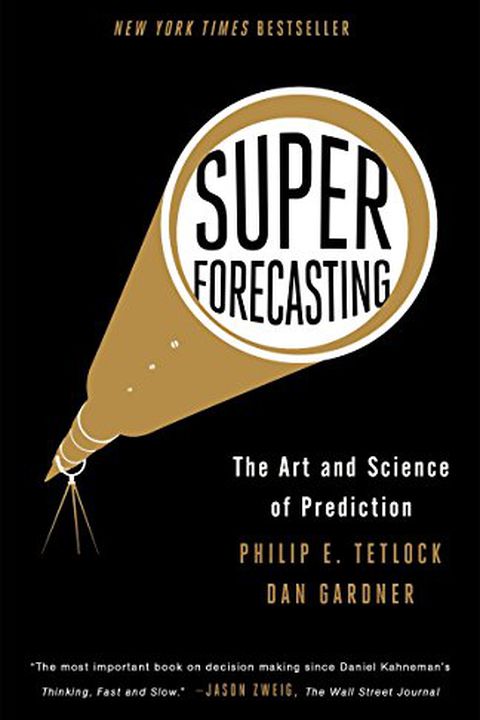
Superforecasting
The Art and Science of Prediction
by Philip E. Tetlock
3 more
More Recommenders
“@JSFinanceDude It's a really good book! | @PTetlock one of the best rationality books i've ever read, I recommend it in many of my talks :) | @jasonzweigwsj is right Superforecasting is most important book since Thinking, Fast & Slow @ptetlock @dgardner | Has some good advice on how to improve your ability to make accurate predictions. | Look, I bought this book on the repeat recommendation of @TimHarford and boy!!!! I feel like screaming after each chapter. So much I didn't even know about myself. EVERY startup founder should read this. A founder’s main job is prediction.”
Source →“@JSFinanceDude It's a really good book! | @PTetlock one of the best rationality books i've ever read, I recommend it in many of my talks :) | @jasonzweigwsj is right Superforecasting is most important book since Thinking, Fast & Slow @ptetlock @dgardner | Has some good advice on how to improve your ability to make accurate predictions. | Look, I bought this book on the repeat recommendation of @TimHarford and boy!!!! I feel like screaming after each chapter. So much I didn't even know about myself. EVERY startup founder should read this. A founder’s main job is prediction.”
Source →“@JSFinanceDude It's a really good book! | @PTetlock one of the best rationality books i've ever read, I recommend it in many of my talks :) | @jasonzweigwsj is right Superforecasting is most important book since Thinking, Fast & Slow @ptetlock @dgardner | Has some good advice on how to improve your ability to make accurate predictions. | Look, I bought this book on the repeat recommendation of @TimHarford and boy!!!! I feel like screaming after each chapter. So much I didn't even know about myself. EVERY startup founder should read this. A founder’s main job is prediction.”
Source →Recommended by 5 notable people, including Michael Mauboussin and Preston Pysh
Check price on AmazonProof-backed recommendation
Amazon availability
Reading Profile
Should I read this?
Superforecasting examines the traits and methods of highly accurate forecasters, linking them to cognitive biases and techniques like belief updating. It outlines an approach to probabilistic thinking, drawing on examples from forecasting tournaments. The density, however, can drag when it lingers on scoring metrics or repeats concepts. Readers wanting a light, prescriptive manual may bounce, but those who persist gain a sharper lens on uncertainty.
Read this if...
- •A product manager in a tech company who needs to estimate launch timelines and feature adoption rates, and wants a systematic way to improve accuracy without relying on gut feel alone.
- •An investor or financial analyst tired of punditry who wants a rigorous approach to assigning probabilities to market events.
- •A policy advisor who must weigh uncertain geopolitical risks and needs tools to communicate probabilities clearly to decision-makers.
Skip this if...
- •You'll likely put it down when the book dives deep into Brier scores and calibration metrics, making it feel more like a statistics textbook than a decision-making guide.
- •Not for you if you want a collection of inspiring anecdotes; the book prioritizes method over motivation and can come off as dryly academic.
- •Skip if you're looking for immediate shortcuts; it requires patient engagement with complex ideas and a willingness to scrutinize your own thinking.
NEW YORK TIMES BESTSELLER NAMED ONE OF THE BEST BOOKS OF THE YEAR BY THE ECONOMIST "The most important book on decision making since Daniel Kahneman's Thinking, Fast and Slow."Jason Zweig, The Wall Street JournalEveryone would benefit from seeing further into the future, whether buying stocks, crafting policy, launching a new product, or simply...
Before You Buy
Reading Specifications
Difficulty:hard
Audience Fit
- A product manager in a tech company who needs to estimate launch timelines and feature adoption rates, and wants a systematic way to improve accuracy without relying on gut feel alone.
- An investor or financial analyst tired of punditry who wants a rigorous approach to assigning probabilities to market events.
- A policy advisor who must weigh uncertain geopolitical risks and needs tools to communicate probabilities clearly to decision-makers.
- You'll likely put it down when the book dives deep into Brier scores and calibration metrics, making it feel more like a statistics textbook than a decision-making guide.
- Not for you if you want a collection of inspiring anecdotes; the book prioritizes method over motivation and can come off as dryly academic.
- Skip if you're looking for immediate shortcuts; it requires patient engagement with complex ideas and a willingness to scrutinize your own thinking.
Check formats, pricing, and availability options for Kindle, physical print, or audiobooks directly.
View available editions on AmazonKey themes
Why recommended
Recommended by 11 sources and appears in Clear Thinking, Economics, and Most Recommended Books.
Recommended by notable people
People and public figures who have recommended this book.
Recommendation Signals
Recommendation proof is sourced from public posts, interviews, reading lists, and cited references.
Preston Pysh
“@JSFinanceDude It's a really good book! | @PTetlock one of the best rationality books i've ever read, I recommend it in many of my talks :) | @jasonzweigwsj is right Superforecasting is most important book since Thinking, Fast & Slow @ptetlock @dgardner | Has some good advice on how to improve your ability to make accurate predictions. | Look, I bought this book on the repeat recommendation of @TimHarford and boy!!!! I feel like screaming after each chapter. So much I didn't even know about myself. EVERY startup founder should read this. A founder’s main job is prediction.”
View sources (5) ▾80%
Appears In
Not sure if this is the right fit?
Consider The Boy, the Mole, the Fox and the Horse by Charlie Mackesy. Recommended by 8 sources.
“Soft-spoken, heavily illustrated fable built from short dialogues and watercolor sketches. Each spread pairs a spare line of text with a loose drawing, so the pleasure is visual and aphoristic rather than narrative; readers collect felt-true sentences more than plot. Most useful when you want quick consolations, a prompt for conversation with a child, or a pause during a rough day. Limiting if you want sustained argument, concrete advice, or tightly plotted storytelling: the repetition of gentleness can feel sentimental or thin after a while.”
Similar books
The Boy, the Mole, the Fox and the Horse
Charlie Mackesy
The World as It Is
Ben Rhodes
Out of Control
Kevin Kelly
The Bully Pulpit
Doris Kearns Goodwin
The Seven Spiritual Laws of Success
Deepak Chopra
Billions and Billions
Carl Sagan
Anger
Gary ChapmanFactfulness
Hans RoslingHow recommendation signals are reviewed
Each recommendation is collected from a public source — interviews, articles, or curated lists — and linked to its original URL. Books with many verifiable recommendations from respected people rank higher.