
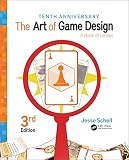
The Art of Game Design
A Book of Lenses, Third Edition
by Jesse Schell
Recommended by Nir Eyal and Ryan Hoover
Check price on AmazonProof-backed recommendation
Amazon availability
Reading Profile
Should I read this?
Jesse Schell reframes game design around listening—paying attention to players, teammates, and contexts—rather than code or engine mechanics. The book supplies practical, craft-minded advice, short heuristics, and many real-world examples aimed at improving how you generate and test play ideas. Its strongest contribution is shifting how teams observe and interpret player behavior during prototyping. Annoyances: repeated examples and broad, attitude-focused guidance that won't satisfy readers seeking step-by-step production pipelines or deep technical instruction. Best read selectively around active design work.
Read this if...
- •indie game designer prototyping a first playable who needs concrete, player-focused ways to gather feedback and iterate quickly
- •product designer moving into games at a tech company who must translate user observation into playable mechanics during short sprints
- •lead designer or producer at a small studio trying to align a team around a shared play vision and improve how playtests are run and discussed
Skip this if...
- •You’ll likely put it down when you expect engine-level tutorials, asset pipelines, or coding recipes—the book avoids technical implementation detail.
- •Annoying if you prefer tightly condensed academic theory or a dense production manual; the text leans on examples, repetition, and attitude over prescriptive checklists.
- •Lose interest if you want detailed schedules, budgets, or studio-process templates; the emphasis is on mindset and observation rather than logistics or code.
Jesse Schell takes an unusual approach to game design, an approach that focuses neither on the technological details of game development nor on the analysis of popular games. Instead, the book will propose that the most important skill for a game designer is not creativity as most suppose, but that of listening. The five kinds of listening (team, c...
Before You Buy
Reading Specifications
Difficulty:easy
Audience Fit
- indie game designer prototyping a first playable who needs concrete, player-focused ways to gather feedback and iterate quickly
- product designer moving into games at a tech company who must translate user observation into playable mechanics during short sprints
- lead designer or producer at a small studio trying to align a team around a shared play vision and improve how playtests are run and discussed
- You’ll likely put it down when you expect engine-level tutorials, asset pipelines, or coding recipes—the book avoids technical implementation detail.
- Annoying if you prefer tightly condensed academic theory or a dense production manual; the text leans on examples, repetition, and attitude over prescriptive checklists.
- Lose interest if you want detailed schedules, budgets, or studio-process templates; the emphasis is on mindset and observation rather than logistics or code.
Check formats, pricing, and availability options for Kindle, physical print, or audiobooks directly.
View available editions on AmazonKey themes
Why recommended
Recommended by 3 sources and appears in Game Design, Game Development, and Game Design.
Recommended by notable people
People and public figures who have recommended this book.
Recommendation Signals
Recommendation proof is sourced from public posts, interviews, reading lists, and cited references.
Ryan Hoover
“Although it's about gaming, the learnings and tactics in the book can be applied to any product. It's really about psychology and how people think.”
Appears In
Not sure if this is the right fit?
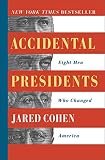
Consider Accidental Presidents by Jared Cohen. Recommended by 10 sources.
“Accidental Presidents offers eight narrative portraits of men who succeeded to the U.S. presidency without election, using anecdote-rich scenes and readable context to show how personality and circumstance interact with office power. It’s strongest as a set of self-contained stories that make succession stakes concrete for non-specialist readers; it does not prioritize dense archival argument or exhaustive methodology, so expect some interpretive generalizations and repeated themes across cases. Use it for fast historical orientation rather than scholarly deep-dives.”
Similar books


How recommendation signals are reviewed
Each recommendation is collected from a public source — interviews, articles, or curated lists — and linked to its original URL. Books with many verifiable recommendations from respected people rank higher.