
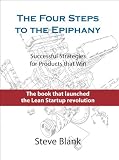
The Four Steps to the Epiphany
Successful Strategies for Products that Win
by Steve Blank
1 more
More Recommenders
“Just finished reading The Four Steps to the Epiphany. Too much (good) info but thankfully there's a summary in the Appendix. | Offers the practical and proven fourstep Customer Development process for search and offers insight into what makes some startups successful and leaves some startups unsuccessful.”
Source →Recommended by 3 notable people, including Andrew Chen and Ryan Hoover
Check price on AmazonProof-backed recommendation
Amazon availability
Reading Profile
Should I read this?
This is a blunt, procedural manual for bringing a product to market: chapters move through customer discovery, hypothesis testing, and building repeatable sales and marketing steps, often presented as checklists and process diagrams. The most useful material is the step-by-step sequence of tests and practical milestones you can apply to avoid building the wrong product. Long procedural passages sacrifice narrative; it's more useful as a reference between meetings than for a straight-through read. Some readers will find the voice brusque rather than conversational.
Read this if...
- •first-time founder in months 0–6 building an MVP who needs a clear sequence of customer-discovery tests to avoid investing in the wrong features.
- •product manager at an early-stage startup shifting from feature work to product–market fit who must set up repeatable sales and go-to-market steps before scaling.
- •founder or consultant drafting a business or marketing plan who needs concrete experiments and testable assumptions to include in a practical action plan.
Skip this if...
- •you'll likely put it down when chapters become long checklists and diagrams—if you wanted lively case storytelling or memoir, this procedural tone will feel dry.
- •annoying if you prefer theory-heavy strategy or academic-style discussion—this book prioritizes operational steps over conceptual depth.
- •frustrating if you wanted hands-on exercises or guided worksheets—the text prescribes steps but lacks fill-in-the-blank exercises or interactive templates.
The essential book for anyone bringing a product to market, writing a business plan, marketing plan or sales plan. Stepbystep strategy of how to successfully organize sales, marketing and business development for a new product or company. The book offers insight into what makes some startups successful and leaves others selling off their furnitur...
Before You Buy
Reading Specifications
Difficulty:hard
Audience Fit
- first-time founder in months 0–6 building an MVP who needs a clear sequence of customer-discovery tests to avoid investing in the wrong features.
- product manager at an early-stage startup shifting from feature work to product–market fit who must set up repeatable sales and go-to-market steps before scaling.
- founder or consultant drafting a business or marketing plan who needs concrete experiments and testable assumptions to include in a practical action plan.
- you'll likely put it down when chapters become long checklists and diagrams—if you wanted lively case storytelling or memoir, this procedural tone will feel dry.
- annoying if you prefer theory-heavy strategy or academic-style discussion—this book prioritizes operational steps over conceptual depth.
- frustrating if you wanted hands-on exercises or guided worksheets—the text prescribes steps but lacks fill-in-the-blank exercises or interactive templates.
Check formats, pricing, and availability options for Kindle, physical print, or audiobooks directly.
View available editions on AmazonKey themes
Why recommended
Recommended by 5 sources and appears in Product Marketing, Entrepreneurship, and Best Startup Books.
Recommended by notable people
People and public figures who have recommended this book.
Recommendation Signals
Recommendation proof is sourced from public posts, interviews, reading lists, and cited references.
Ryan Hoover
“Just finished reading The Four Steps to the Epiphany. Too much (good) info but thankfully there's a summary in the Appendix. | Offers the practical and proven fourstep Customer Development process for search and offers insight into what makes some startups successful and leaves some startups unsuccessful.”
View sources (2) ▾80%
Appears In
Not sure if this is the right fit?
Consider Accidental Presidents by Jared Cohen. Recommended by 10 sources.
“Accidental Presidents offers eight narrative portraits of men who succeeded to the U.S. presidency without election, using anecdote-rich scenes and readable context to show how personality and circumstance interact with office power. It’s strongest as a set of self-contained stories that make succession stakes concrete for non-specialist readers; it does not prioritize dense archival argument or exhaustive methodology, so expect some interpretive generalizations and repeated themes across cases. Use it for fast historical orientation rather than scholarly deep-dives.”
Similar books



How recommendation signals are reviewed
Each recommendation is collected from a public source — interviews, articles, or curated lists — and linked to its original URL. Books with many verifiable recommendations from respected people rank higher.