
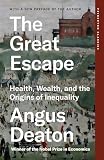
The Great Escape
Health, Wealth, and the Origins of Inequality
by Angus Deaton


Recommended by Bill Gates and Jordan Peterson
Check price on AmazonProof-backed recommendation
Amazon availability
Reading Profile
Should I read this?
The Great Escape reads like a historian's sweep fitted to an economist's toolkit: broad, data-rich chapters tracing two-and-a-half centuries of life-expectancy and income change. Its useful part is the big-picture synthesis—clear explanations of why average people became healthier and richer, and how those gains left stark inequalities. Limitation: the narrative repeatedly returns to statistical evidence and policy argumentation, which can feel dense and argumentative rather than story-driven. Expect few personal anecdotes and almost no hands-on exercises.
Read this if...
- •a public-health analyst drafting a policy briefing on mortality decline who needs historical, data-backed explanations to frame current recommendations
- •a development-policy adviser preparing to argue about growth versus redistribution and wanting concise, quantitative historical context for meetings or presentations
- •a secondary-school history teacher or curious non-specialist assembling a lesson on modern economic history who wants readable, math-light summaries rather than character-driven case studies
Skip this if...
- •you'll likely put it down when the prose shifts into dense statistical chapters and repeated policy arguments — the middle sections slow to a lecture-like pace
- •annoying if you prefer character-led storytelling or vivid anecdotes; this is macro-level economic history with few human-interest vignettes
- •if you want practical takeaways or exercises, this book has no exercises and offers little step-by-step guidance
A Nobel Prizewinning economist tells the remarkable story of how the world has grown healthier, wealthier, but also more unequal over the past two and half centuriesThe world is a better place than it used to be. People are healthier, wealthier, and live longer. Yet the escapes from destitution by so many has left gaping inequalities between peopl...
Before You Buy
Reading Specifications
Difficulty:hard
Audience Fit
- a public-health analyst drafting a policy briefing on mortality decline who needs historical, data-backed explanations to frame current recommendations
- a development-policy adviser preparing to argue about growth versus redistribution and wanting concise, quantitative historical context for meetings or presentations
- a secondary-school history teacher or curious non-specialist assembling a lesson on modern economic history who wants readable, math-light summaries rather than character-driven case studies
- you'll likely put it down when the prose shifts into dense statistical chapters and repeated policy arguments — the middle sections slow to a lecture-like pace
- annoying if you prefer character-led storytelling or vivid anecdotes; this is macro-level economic history with few human-interest vignettes
- if you want practical takeaways or exercises, this book has no exercises and offers little step-by-step guidance
Check formats, pricing, and availability options for Kindle, physical print, or audiobooks directly.
View available editions on AmazonKey themes
Why recommended
Recommended by 4 sources and appears in Most Recommended Books, Finance, and History.
Recommended by notable people
People and public figures who have recommended this book.
Recommendation Signals
Recommendation proof is sourced from public posts, interviews, reading lists, and cited references.
Bill Gates
Co-founder of Microsoft; co-chair of the Gates Foundation
“If you want to learn about why human welfare overall has gone up so much over time, you should read The Great Escape.”
Ready to read The Great Escape?
Check formats, pricing, and availability options directly on Amazon.
Appears In
Not sure if this is the right fit?
Consider The Undoing Project by Michael Lewis. Recommended by 18 sources.
“Michael Lewis chronicles the friendship and intellectual partnership of Daniel Kahneman and Amos Tversky, who championed the idea that cognitive biases shape our choices. The narrative reads like a buddy story, weaving their discoveries into personal anecdotes and the drama of their collaboration. You'll grasp key ideas—loss aversion, framing—through their story, but the book focuses on biography, not application. Helpful for understanding behavioral economics' origins; less useful if you want actionable advice. The emotional arc of their relationship can overshadow the science.”
Similar books

How recommendation signals are reviewed
Each recommendation is collected from a public source — interviews, articles, or curated lists — and linked to its original URL. Books with many verifiable recommendations from respected people rank higher.