
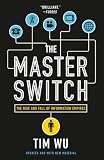
The Master Switch
The Rise and Fall of Information Empires
by Tim Wu
3 more
More Recommenders
“@MikeDrewWhat @pareene @brianbeutler Tim Wu's book The Master Switch is amazing about how much a recurring pattern this is. | @deepakabbot Would recommend reading this for tug of war between government and communications monopolies over the past century. The Master Switch by @superwuster | I do agree that all networks tend toward centralization over time. Great book on this | Now starting the section now these information empires eventually got dismantled, by the internet, cable, and the government antitrust efforts on the 1950s! Awesome book so far”
Source →“@MikeDrewWhat @pareene @brianbeutler Tim Wu's book The Master Switch is amazing about how much a recurring pattern this is. | @deepakabbot Would recommend reading this for tug of war between government and communications monopolies over the past century. The Master Switch by @superwuster | I do agree that all networks tend toward centralization over time. Great book on this | Now starting the section now these information empires eventually got dismantled, by the internet, cable, and the government antitrust efforts on the 1950s! Awesome book so far”
Source →“@MikeDrewWhat @pareene @brianbeutler Tim Wu's book The Master Switch is amazing about how much a recurring pattern this is. | @deepakabbot Would recommend reading this for tug of war between government and communications monopolies over the past century. The Master Switch by @superwuster | I do agree that all networks tend toward centralization over time. Great book on this | Now starting the section now these information empires eventually got dismantled, by the internet, cable, and the government antitrust efforts on the 1950s! Awesome book so far”
Source →Recommended by 5 notable people, including Cleo Abram and Brian Armstrong
Check price on AmazonProof-backed recommendation
Amazon availability
Reading Profile
Should I read this?
Starts with vivid historical narratives—telephone, radio, film—and follows how open, competitive origins gave way to concentrated control. The most useful material is the sequence of case studies and the way patterns reappear across different industries, which helps you see recurring market dynamics. Readers who want econometric detail or hands-on policy playbooks will be disappointed: the argument is qualitative and occasionally repetitive. Midbook sections restate similar consolidation arcs; the prose favors clarity and storytelling over technical density or prescriptive solutions.
Read this if...
- •a competition-policy analyst at a telecom regulator drafting comments on market power — useful for mapping historical consolidation cycles to contemporary rulemaking trade-offs
- •a startup founder deciding whether to integrate with a dominant platform — helpful for anticipating lock-in risks and planning strategic partnership choices
- •a business or technology journalist researching a feature on platform dominance — provides narrative case studies and precedents to illustrate an argument
Skip this if...
- •you'll likely put it down when the narrative cycles through similar monopoly episodes—midbook repetition replaces new evidence and momentum
- •annoying if you prefer data-heavy, econometric analysis instead of qualitative history and storytelling
- •not helpful if you want hands-on solutions or exercises—no exercises and few prescriptive playbooks
It is easy to forget that every development in the history of the American information industryfrom the telephone to radio to filmonce existed in an open and chaotic marketplace inhabited by entrepreneurs and utopians, just as the Internet does today. Each of these, however, grew to be dominated by a monopolist or cartel. In this pathbreaking book,...
Before You Buy
Reading Specifications
Difficulty:hard
Audience Fit
- a competition-policy analyst at a telecom regulator drafting comments on market power — useful for mapping historical consolidation cycles to contemporary rulemaking trade-offs
- a startup founder deciding whether to integrate with a dominant platform — helpful for anticipating lock-in risks and planning strategic partnership choices
- a business or technology journalist researching a feature on platform dominance — provides narrative case studies and precedents to illustrate an argument
- you'll likely put it down when the narrative cycles through similar monopoly episodes—midbook repetition replaces new evidence and momentum
- annoying if you prefer data-heavy, econometric analysis instead of qualitative history and storytelling
- not helpful if you want hands-on solutions or exercises—no exercises and few prescriptive playbooks
Check formats, pricing, and availability options for Kindle, physical print, or audiobooks directly.
View available editions on AmazonKey themes
Why recommended
Recommended by 7 sources and appears in Most Recommended Books, Technology, and Business.
Recommended by notable people
People and public figures who have recommended this book.
Recommendation Signals
Recommendation proof is sourced from public posts, interviews, reading lists, and cited references.
Cleo Abram
“@MikeDrewWhat @pareene @brianbeutler Tim Wu's book The Master Switch is amazing about how much a recurring pattern this is. | @deepakabbot Would recommend reading this for tug of war between government and communications monopolies over the past century. The Master Switch by @superwuster | I do agree that all networks tend toward centralization over time. Great book on this | Now starting the section now these information empires eventually got dismantled, by the internet, cable, and the government antitrust efforts on the 1950s! Awesome book so far”
View sources (4) ▾80%
Appears In

Not sure if this is the right fit?
Consider Accidental Presidents by Jared Cohen. Recommended by 10 sources.
“Accidental Presidents offers eight narrative portraits of men who succeeded to the U.S. presidency without election, using anecdote-rich scenes and readable context to show how personality and circumstance interact with office power. It’s strongest as a set of self-contained stories that make succession stakes concrete for non-specialist readers; it does not prioritize dense archival argument or exhaustive methodology, so expect some interpretive generalizations and repeated themes across cases. Use it for fast historical orientation rather than scholarly deep-dives.”
Similar books




How recommendation signals are reviewed
Each recommendation is collected from a public source — interviews, articles, or curated lists — and linked to its original URL. Books with many verifiable recommendations from respected people rank higher.