
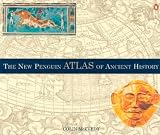
The New Penguin Atlas of Ancient History
Revised Edition
by Colin McEvedy

Reading Profile
Should I read this?
The atlas reads as a map-first tour through ancient Europe, the Mediterranean and the Near East, from 50,000 B.C. to the fourth century A.D. Its useful part is the sweep: chronological maps turn migrations, borders and demographic shifts into a single visual thread that’s easy to follow. Expect minimal interpretive prose and compact captions rather than deep argument; that economy keeps the book focused but can feel reductive or repetitive if you wanted narrative, dense citing, or sustained local detail.
Read this if...
- •an undergraduate ancient-history student preparing a map-based assignment who needs quick visual timelines of migrations and political change
- •a high-school history teacher building a lecture or slide deck who wants clear maps to show how borders and populations shift over millennia
- •an independent history reader or traveler orienting themselves to archaeological regions who needs fast geographic context before deeper reading or site visits
Skip this if...
- •you who want a storytelling history — you'll likely put it down within the first third when you expect continuous narrative and instead find mostly maps and short captions
- •you doing academic research or needing dense sourcing — annoying if you prefer long-footnote chapters and detailed historiographical argument, because commentary and citations are spare
- •you who dislike repetition or schematic simplifications — you'll lose patience by the book’s midpoint as similar map templates recur and geographic reductions start to feel flattening
The Penguin Atlas of Ancient History illustrates in a chronological series of maps, the evolution and flux of races in Europe, the Mediterranean area and the Near East. From 50,000 B.C. to the fourth century A.D., it is one of the most successful of the bestselling historical atlas series....
Before You Buy
Reading Specifications
Difficulty:easy
Audience Fit
- an undergraduate ancient-history student preparing a map-based assignment who needs quick visual timelines of migrations and political change
- a high-school history teacher building a lecture or slide deck who wants clear maps to show how borders and populations shift over millennia
- an independent history reader or traveler orienting themselves to archaeological regions who needs fast geographic context before deeper reading or site visits
- you who want a storytelling history — you'll likely put it down within the first third when you expect continuous narrative and instead find mostly maps and short captions
- you doing academic research or needing dense sourcing — annoying if you prefer long-footnote chapters and detailed historiographical argument, because commentary and citations are spare
- you who dislike repetition or schematic simplifications — you'll lose patience by the book’s midpoint as similar map templates recur and geographic reductions start to feel flattening
Check formats, pricing, and availability options for Kindle, physical print, or audiobooks directly.
View available editions on AmazonKey themes
Why recommended
Recommended by 2 sources and appears in Books Recommended by Paul Graham, Most Recommended Books, and History.
Recommended by notable people
People and public figures who have recommended this book.
Recommendation Signals
Recommendation proof is sourced from public posts, interviews, reading lists, and cited references.
Paul Graham
Co-founder of Y Combinator; essayist
“Q: What should I read to learn more about history PG: Here are the most exciting ones I can think of.”
Ready to read The New Penguin Atlas of Ancient History?
Check formats, pricing, and availability options directly on Amazon.
Appears In
Not sure if this is the right fit?
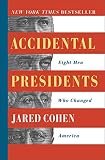
Consider Accidental Presidents by Jared Cohen. Recommended by 10 sources.
“Accidental Presidents offers eight narrative portraits of men who succeeded to the U.S. presidency without election, using anecdote-rich scenes and readable context to show how personality and circumstance interact with office power. It’s strongest as a set of self-contained stories that make succession stakes concrete for non-specialist readers; it does not prioritize dense archival argument or exhaustive methodology, so expect some interpretive generalizations and repeated themes across cases. Use it for fast historical orientation rather than scholarly deep-dives.”
Similar books



How recommendation signals are reviewed
Each recommendation is collected from a public source — interviews, articles, or curated lists — and linked to its original URL. Books with many verifiable recommendations from respected people rank higher.