
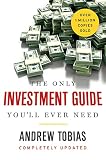
The Only Investment Guide You'll Ever Need
by Andrew Tobias
Recommended by Mark Cuban and Jeffrey Snover
Check price on AmazonProof-backed recommendation
Amazon availability
Reading Profile
Should I read this?
The Only Investment Guide You'll Ever Need reads as a plainspoken primer packed with quick, actionable tips on saving, asset allocation, and everyday money management. Its useful part is short, practical advice aimed at people who want clear steps without jargon. Limitations: some examples and product references show their age, and readers seeking deep technical portfolio math or current platform screenshots will be disappointed. Best used as a readable orientation and checklist rather than a technical manual.
Read this if...
- •a mid-level software engineer enrolling in a new employer 401(k) who needs concrete next steps (how much to contribute, Roth vs. pretax, and simple fund-pick rules) rather than technical portfolio modeling
- •a sole proprietor running a small, cash-variable service business who wants straightforward rules for building an emergency fund, automating savings, and picking low-fee options without spreadsheet-heavy allocation formulas
- •a couple approaching retirement who must consolidate accounts and choose drawdown and rebalancing priorities and who wants plain-language checklists and fee-awareness before deciding whether to hire professional help
Skip this if...
- •you'll likely put it down when the book's dated product references and repeated anecdotes pile up — that mid-section can feel less useful to readers wanting modern specifics
- •annoying if you prefer heavily data-driven charts, portfolio math, or algorithmic asset allocation — this is light on technical depth
- •not a fit if you want step-by-step online platform tutorials or very recent investment vehicles; the book lacks up-to-the-minute how‑tos
?The Only Investment Guide You'll Ever Need . . . actually lives up to its name.? ? Los Angeles Times ?So full of tips and angles that only a booby or a billionaire could not benefit.? ? New York Times For nearly forty years, The Only Investment Guide You'll Ever Need has been a favorite finance guide, earning the allegiance of more than a million ...
Before You Buy
Reading Specifications
Difficulty:easy
Audience Fit
- a mid-level software engineer enrolling in a new employer 401(k) who needs concrete next steps (how much to contribute, Roth vs. pretax, and simple fund-pick rules) rather than technical portfolio modeling
- a sole proprietor running a small, cash-variable service business who wants straightforward rules for building an emergency fund, automating savings, and picking low-fee options without spreadsheet-heavy allocation formulas
- a couple approaching retirement who must consolidate accounts and choose drawdown and rebalancing priorities and who wants plain-language checklists and fee-awareness before deciding whether to hire professional help
- you'll likely put it down when the book's dated product references and repeated anecdotes pile up — that mid-section can feel less useful to readers wanting modern specifics
- annoying if you prefer heavily data-driven charts, portfolio math, or algorithmic asset allocation — this is light on technical depth
- not a fit if you want step-by-step online platform tutorials or very recent investment vehicles; the book lacks up-to-the-minute how‑tos
Check formats, pricing, and availability options for Kindle, physical print, or audiobooks directly.
View available editions on AmazonKey themes
Why recommended
Recommended by 3 sources and appears in Best Investing Books, Most Recommended Books, and Finance.
Recommended by notable people
People and public figures who have recommended this book.
Recommendation Signals
Recommendation proof is sourced from public posts, interviews, reading lists, and cited references.
Mark Cuban
“@AndrewTobias wrote a fantastic book about how to think about money, spending, saving, and investing. If you don't have these things in focus, I can STRONGLY recommend this book. | This is the only investment book I have read that truly made sense. Bottom line is that you can take a measure of risk on the $5,000 you have to invest in an attempt to earn 10 percent in the stock market, while praying that it all doesn't disappear because someone bought too many yen derivatives. Or you can save 15 percent on the $5,000 a year you spend on replenishables, from toilet paper to cereal to who knows what, and put it in the bank on top of the original $5,000, earn an easy 5 percent, plus accrued interest, on the total and sleep very, very well at night.”
View sources (2) ▾80%
Appears In
Not sure if this is the right fit?
Consider The Undoing Project by Michael Lewis. Recommended by 18 sources.
“Michael Lewis chronicles the friendship and intellectual partnership of Daniel Kahneman and Amos Tversky, who championed the idea that cognitive biases shape our choices. The narrative reads like a buddy story, weaving their discoveries into personal anecdotes and the drama of their collaboration. You'll grasp key ideas—loss aversion, framing—through their story, but the book focuses on biography, not application. Helpful for understanding behavioral economics' origins; less useful if you want actionable advice. The emotional arc of their relationship can overshadow the science.”
Similar books
The Undoing Project
Michael Lewis
The Little Book of Common Sense Investing
John C. Bogle
Financial Shenanigans
Howard Schilit
Scale
Geoffrey West
Poor Numbers
Morten Jerven
The Great Illusion
Norman Angell
One Billion Americans
Matthew Yglesias
Accounting Principles Standalone book
Jerry J. WeygandtHow recommendation signals are reviewed
Each recommendation is collected from a public source — interviews, articles, or curated lists — and linked to its original URL. Books with many verifiable recommendations from respected people rank higher.