
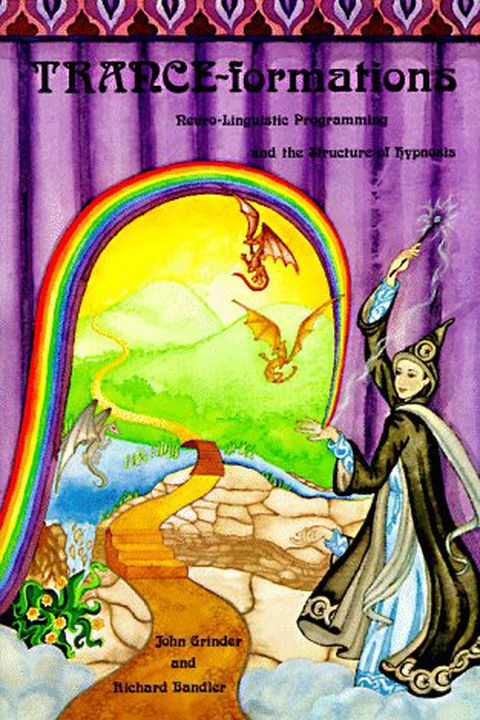
TranceFormations
NeuroLinguistic Programming, and the Structure of Hypnosis
by John Grinder
Reading Profile
Should I read this?
TranceFormations reads like a technique-heavy manual centered on trance states, revisiting earlier trance access, and using pattern interruption plus reframing to drive “generative change.” It also keeps coming back to how to avoid using these ideas unproductively. The most useful parts are the ones tying the concepts to real-world communication. The annoying part is trust friction: the tone can feel abstract and confidence-heavy, with some sections feeling more procedural than carefully bounded.
Read this if...
- •A customer-success manager preparing for recurring difficult conversations at work, because the book connects pattern interruption and reframing to changing what happens in the moment
- •A team lead coaching a direct report stuck in a repeating communication rut, because it frames change in terms of shifting trance/state patterns rather than only swapping talking points
- •A self-directed learner interested in altered-state concepts who wants to revisit “previous trance states,” because it explicitly discusses trance access and returning to prior states as part of the approach
Skip this if...
- •If you want externally grounded, cautious explanations, you’ll likely lose interest when the writing prioritizes plausibility and technique talk over clear support boundaries
- •If you prefer lighter reading with minimal instruction, you’ll get impatient if it turns relentlessly procedural and concept-dense
- •If you’re looking for strong, explicit boundary-setting for misuse prevention, you may feel uneasy because the guidance about keeping use productive can feel too general
What is a trance state How do you access a previous trance state What is pattern interruption Stacked realities Generative change Reframing And how in the world do you use all this stuff to do anything productive Better yet, how do you keep from using all this stuff to be unproductive Well, this will give a you a taste of what lies in store...
Before You Buy
Reading Specifications
Difficulty:hard
Audience Fit
- A customer-success manager preparing for recurring difficult conversations at work, because the book connects pattern interruption and reframing to changing what happens in the moment
- A team lead coaching a direct report stuck in a repeating communication rut, because it frames change in terms of shifting trance/state patterns rather than only swapping talking points
- A self-directed learner interested in altered-state concepts who wants to revisit “previous trance states,” because it explicitly discusses trance access and returning to prior states as part of the approach
- If you want externally grounded, cautious explanations, you’ll likely lose interest when the writing prioritizes plausibility and technique talk over clear support boundaries
- If you prefer lighter reading with minimal instruction, you’ll get impatient if it turns relentlessly procedural and concept-dense
- If you’re looking for strong, explicit boundary-setting for misuse prevention, you may feel uneasy because the guidance about keeping use productive can feel too general
Check formats, pricing, and availability options for Kindle, physical print, or audiobooks directly.
View available editions on AmazonKey themes
Why recommended
appears in Neuro Linguistic Programming, Hypnosis, and Psychology.
Recommendation Signals
Recommendation proof is sourced from public posts, interviews, reading lists, and cited references.
No verified recommendation proof available yet.
Appears In
Not sure if this is the right fit?
Consider The Boy, the Mole, the Fox and the Horse by Charlie Mackesy. Recommended by 8 sources.
“Soft-spoken, heavily illustrated fable built from short dialogues and watercolor sketches. Each spread pairs a spare line of text with a loose drawing, so the pleasure is visual and aphoristic rather than narrative; readers collect felt-true sentences more than plot. Most useful when you want quick consolations, a prompt for conversation with a child, or a pause during a rough day. Limiting if you want sustained argument, concrete advice, or tightly plotted storytelling: the repetition of gentleness can feel sentimental or thin after a while.”
Similar books
The Boy, the Mole, the Fox and the Horse
Charlie Mackesy
The World as It Is
Ben Rhodes
Out of Control
Kevin Kelly
The Bully Pulpit
Doris Kearns Goodwin
The Seven Spiritual Laws of Success
Deepak Chopra
Billions and Billions
Carl Sagan
Anger
Gary ChapmanFactfulness
Hans RoslingHow recommendation signals are reviewed
Each recommendation is collected from a public source — interviews, articles, or curated lists — and linked to its original URL. Books with many verifiable recommendations from respected people rank higher.