
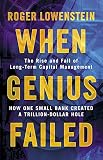
When Genius Failed
The Rise and Fall of Long Term Capital Management
by Roger Lowenstein
2 more
More Recommenders
“@hamporter36 @FWIWmacro Soros on Soros, Manias Crashes and Panics, Market Wizards, Lords of Finance, The House of Money, Investment Biker, The New Silk Roads, When Genius Failed, The Black Swan, John Murphy Technical Analysis of the financial markets, This Time is Different | Favourite business book advise to young entrepreneurs.”
Source →“@hamporter36 @FWIWmacro Soros on Soros, Manias Crashes and Panics, Market Wizards, Lords of Finance, The House of Money, Investment Biker, The New Silk Roads, When Genius Failed, The Black Swan, John Murphy Technical Analysis of the financial markets, This Time is Different | Favourite business book advise to young entrepreneurs.”
Source →Recommended by 4 notable people, including Raoul Pal and Max Levchin
Check price on AmazonProof-backed recommendation
Amazon availability
Reading Profile
Should I read this?
Lowenstein lays out Long-Term Capital Management’s ascent and collapse through scene-driven narrative, market timelines, and plain-language explanations of leverage and derivatives. Early chapters move briskly, introducing characters and the fund’s confident strategies; much of the middle dwells on technical breakdowns and repeated timeline recaps that can feel dense. Usefulness comes from the concrete account of how model certainty and interbank ties magnified losses; its main limitation is that technical digressions will test readers who prefer a lighter, less detail-heavy business narrative.
Read this if...
- •risk manager at a commercial or investment bank trying to argue for stricter counterparty and leverage limits after a near-miss — the book supplies a vivid real-world example of contagion dynamics and creditor negotiation.
- •graduate student in finance or economic history researching hedge funds and systemic risk who needs a readable historical case tracing strategy, leverage mechanics, and institutional responses.
- •portfolio manager or analyst who must explain derivatives and tail-risk to nontechnical stakeholders — the narrative anecdotes and explained missteps provide concrete talking points for why models can fail in stressed markets.
Skip this if...
- •You'll likely put it down when the narrative pauses for long, detailed breakdowns of derivatives, payoff structures, and model minutiae — tedious if you wanted a brisk business thriller.
- •Annoying if you prefer prescriptive takeaways or practical checklists — this is narrative history, not a how-to manual, and it lacks hands-on exercises.
- •Not for readers who avoid finance jargon or dense timeline recap: repeated meeting-by-meeting negotiations and iterative market summaries can feel repetitive and slow the momentum.
This title tells the story of longterm capital management where a group of elite investors believe they can beat the market and, like alchemists, create limitless wealth for themselves and their partners. In fact, they create a trilliondollar hole in the international banking system....
Before You Buy
Reading Specifications
Difficulty:hard
Audience Fit
- risk manager at a commercial or investment bank trying to argue for stricter counterparty and leverage limits after a near-miss — the book supplies a vivid real-world example of contagion dynamics and creditor negotiation.
- graduate student in finance or economic history researching hedge funds and systemic risk who needs a readable historical case tracing strategy, leverage mechanics, and institutional responses.
- portfolio manager or analyst who must explain derivatives and tail-risk to nontechnical stakeholders — the narrative anecdotes and explained missteps provide concrete talking points for why models can fail in stressed markets.
- You'll likely put it down when the narrative pauses for long, detailed breakdowns of derivatives, payoff structures, and model minutiae — tedious if you wanted a brisk business thriller.
- Annoying if you prefer prescriptive takeaways or practical checklists — this is narrative history, not a how-to manual, and it lacks hands-on exercises.
- Not for readers who avoid finance jargon or dense timeline recap: repeated meeting-by-meeting negotiations and iterative market summaries can feel repetitive and slow the momentum.
Check formats, pricing, and availability options for Kindle, physical print, or audiobooks directly.
View available editions on AmazonKey themes
Why recommended
Recommended by 8 sources and appears in Trading, Stock Market, and Stock Trading.
Recommended by notable people
People and public figures who have recommended this book.
Recommendation Signals
Recommendation proof is sourced from public posts, interviews, reading lists, and cited references.
Max Levchin
“@hamporter36 @FWIWmacro Soros on Soros, Manias Crashes and Panics, Market Wizards, Lords of Finance, The House of Money, Investment Biker, The New Silk Roads, When Genius Failed, The Black Swan, John Murphy Technical Analysis of the financial markets, This Time is Different | Favourite business book advise to young entrepreneurs.”
View sources (2) ▾80%
Appears In
Not sure if this is the right fit?
Consider The Undoing Project by Michael Lewis. Recommended by 18 sources.
“Michael Lewis chronicles the friendship and intellectual partnership of Daniel Kahneman and Amos Tversky, who championed the idea that cognitive biases shape our choices. The narrative reads like a buddy story, weaving their discoveries into personal anecdotes and the drama of their collaboration. You'll grasp key ideas—loss aversion, framing—through their story, but the book focuses on biography, not application. Helpful for understanding behavioral economics' origins; less useful if you want actionable advice. The emotional arc of their relationship can overshadow the science.”
Similar books
The Undoing Project
Michael Lewis
The Little Book of Common Sense Investing
John C. Bogle
Financial Shenanigans
Howard Schilit
Scale
Geoffrey West
Poor Numbers
Morten Jerven
The Great Illusion
Norman Angell
One Billion Americans
Matthew Yglesias
Accounting Principles Standalone book
Jerry J. WeygandtHow recommendation signals are reviewed
Each recommendation is collected from a public source — interviews, articles, or curated lists — and linked to its original URL. Books with many verifiable recommendations from respected people rank higher.