
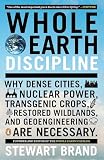
Whole Earth Discipline
Why Dense Cities, Nuclear Power, Transgenic Crops, Restored Wildlands, and Geoengineering Are Necessary
by Stewart Brand


2 more
More Recommenders
“Children of the 1970s will appreciate the title, an allusion to the author's groundbreaking 'Whole Earth Catalog,' which merged Technology, with the counterculture and encouraged global consciousness with the breathtaking earthrise photograph on the cover. | Incredible book by @stewartbrand. Best I’ve read this year. “Cities are green. Nuclear energy is green. Genetic engineering is green.” | On why even environmentalists should be pro building, pro cities, pro nuclear, and pro genetic engineering.”
Source →“Children of the 1970s will appreciate the title, an allusion to the author's groundbreaking 'Whole Earth Catalog,' which merged Technology, with the counterculture and encouraged global consciousness with the breathtaking earthrise photograph on the cover. | Incredible book by @stewartbrand. Best I’ve read this year. “Cities are green. Nuclear energy is green. Genetic engineering is green.” | On why even environmentalists should be pro building, pro cities, pro nuclear, and pro genetic engineering.”
Source →Recommended by 4 notable people, including Patrick Collison and Marc Andreessen
Check price on AmazonProof-backed recommendation
Amazon availability
Reading Profile
Should I read this?
Starts as a brisk, science-focused challenge to mainstream environmental assumptions, pushing readers to rethink which interventions deserve support. The book’s useful part is its argument-driven reassessment — it supplies policy-minded, often technology-friendly reasons to revise orthodox positions rather than sentimental appeals. The main limitation is tone and scope: Brand can sound polemical and selective, and the book favors big-picture argument over granular roadmaps or step-by-step implementation, which will frustrate readers wanting practical next steps.
Read this if...
- •environment-policy analyst weighing trade-offs in regulatory debates — useful now when you must argue for or against unconventional interventions with data-oriented reasoning
- •urban planner defending density and infrastructure investment — helpful if you need language and arguments that prioritize systems-level solutions over nostalgia for sprawl
- •science-minded activist rethinking strategy — good when you’re ready to test long-held green assumptions and want contrarian evidence to inform tactical shifts
Skip this if...
- •you’ll likely put it down when the text piles up technical counters and policy claims without offering concrete, stepwise solutions — the middle section can feel argument-heavy and thin on practical follow-through
- •annoying if you prefer lyrical or values-first environmental writing — this is argumentative and policy-focused, not poetic nature prose
- •not suitable if you want a hands-on guide or exercises — lacks step-by-step tools and practical checklists
"Incredible book . . . Best I've read this year." Jack Dorsey, via Twitter This eyeopening book by the legendary author of the National Book Awardwinning Whole Earth Catalog persuasively details a new approach to our stewardship of the planet. Lifelong ecologist and futurist Stewart Brand relies on scientific rigor to shatter myths concerning n...
Before You Buy
Reading Specifications
Difficulty:hard
Audience Fit
- environment-policy analyst weighing trade-offs in regulatory debates — useful now when you must argue for or against unconventional interventions with data-oriented reasoning
- urban planner defending density and infrastructure investment — helpful if you need language and arguments that prioritize systems-level solutions over nostalgia for sprawl
- science-minded activist rethinking strategy — good when you’re ready to test long-held green assumptions and want contrarian evidence to inform tactical shifts
- you’ll likely put it down when the text piles up technical counters and policy claims without offering concrete, stepwise solutions — the middle section can feel argument-heavy and thin on practical follow-through
- annoying if you prefer lyrical or values-first environmental writing — this is argumentative and policy-focused, not poetic nature prose
- not suitable if you want a hands-on guide or exercises — lacks step-by-step tools and practical checklists
Check formats, pricing, and availability options for Kindle, physical print, or audiobooks directly.
View available editions on AmazonKey themes
Why recommended
Recommended by 9 sources and appears in Most Recommended Books, Finance, and Politics.
Recommended by notable people
People and public figures who have recommended this book.
Recommendation Signals
Recommendation proof is sourced from public posts, interviews, reading lists, and cited references.
Steven Pinker
“Children of the 1970s will appreciate the title, an allusion to the author's groundbreaking 'Whole Earth Catalog,' which merged Technology, with the counterculture and encouraged global consciousness with the breathtaking earthrise photograph on the cover. | Incredible book by @stewartbrand. Best I’ve read this year. “Cities are green. Nuclear energy is green. Genetic engineering is green.” | On why even environmentalists should be pro building, pro cities, pro nuclear, and pro genetic engineering.”
View sources (3) ▾80%
Appears In
Not sure if this is the right fit?
Consider The Boy, the Mole, the Fox and the Horse by Charlie Mackesy. Recommended by 8 sources.
“Soft-spoken, heavily illustrated fable built from short dialogues and watercolor sketches. Each spread pairs a spare line of text with a loose drawing, so the pleasure is visual and aphoristic rather than narrative; readers collect felt-true sentences more than plot. Most useful when you want quick consolations, a prompt for conversation with a child, or a pause during a rough day. Limiting if you want sustained argument, concrete advice, or tightly plotted storytelling: the repetition of gentleness can feel sentimental or thin after a while.”
Similar books
The Boy, the Mole, the Fox and the Horse
Charlie Mackesy
The World as It Is
Ben Rhodes
Out of Control
Kevin Kelly
The Bully Pulpit
Doris Kearns Goodwin
The Seven Spiritual Laws of Success
Deepak Chopra
Billions and Billions
Carl Sagan
Anger
Gary ChapmanFactfulness
Hans RoslingHow recommendation signals are reviewed
Each recommendation is collected from a public source — interviews, articles, or curated lists — and linked to its original URL. Books with many verifiable recommendations from respected people rank higher.