
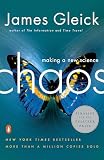
Chaos
Making a New Science
by James Gleick

1 more
More Recommenders
“@patrickc For example, while trying to find the poetry in tough science for my heredity book, I picked up Chaos by @JamesGleick again. Helped a lot | An excellent book, suffused with poetry. A 20thcentury classic.”
Source →Recommended by 3 notable people, including Naval Ravikant and Joyce Oates
Check price on AmazonProof-backed recommendation
Amazon availability
Should I read this?
Recommended by 3 sources and appears in Best Science Books, Science, and Nonfiction.
Few writers distinguish themselves by their ability to write about complicated, even obscure topics clearly and engagingly. In Chaos, James Gleick, a former science writer for the New York Times, shows that he resides in this exclusive category. Here he takes on the job of depicting the first years of the study of chaosthe seemingly random patter...
Looking for Kindle, hardcover, paperback, or audiobook editions?
Check formats, pricing, and current availability directly.
Why recommended
Recommended by 3 sources and appears in Best Science Books, Science, and Nonfiction.
Recommended by notable people
People and public figures who have recommended this book.
Recommendation Signals
Recommendation proof is sourced from public posts, interviews, reading lists, and cited references.
Carl Zimmer
“@patrickc For example, while trying to find the poetry in tough science for my heredity book, I picked up Chaos by @JamesGleick again. Helped a lot | An excellent book, suffused with poetry. A 20thcentury classic.”
View sources (2) ▾80%
Appears In
Not sure if this is the right fit?
Consider Infinite Powers by Steven Strogatz. Recommended by 10 sources.
“Strogatz writes like an engaging guide who treats calculus as a human story: equations come with everyday analogies, historical side trips, and visual intuition. What works best is making why calculus matters—velocity, accumulation, and infinity—feel concrete without heavy formalism, so a reader finishes with better conceptual tools for understanding technology and science. The main limitation is pace: readers wanting rigorous proofs or a practice-based learning path will find it light and occasionally repetitive in examples and anecdotes.”
Similar books
Infinite Powers
Steven Strogatz
Complexity
Roger Lewin
Elements of Information Theory
Thomas M. CoverGödel, Escher, Bach
Douglas R. Hofstadter
How to Lie with Statistics
Darrell Huff
One Two Three . . . Infinity
George Gamow
Euclid's Elements
Euclid
The Art of Statistics
David SpiegelhalterHow recommendation signals are reviewed
Each recommendation is collected from a public source — interviews, articles, or curated lists — and linked to its original URL. Books with many verifiable recommendations from respected people rank higher.