
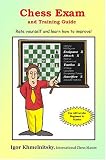
Chess Exam and Training Guide
Rate Yourself And Learn How To Improve
by Igor Khmelnitsky
Reading Profile
Should I read this?
Igor Khmelnitsky's Chess Exam And Training Guide reads like a coach's written test: 200 questions across 100 diagrams let you probe tactics, basic endgames, and pattern recognition, then check comprehensive answers. What works best is rapid self-evaluation and a practical map of concrete strengths and weaknesses without a teacher. Limitations include isolated diagram problems rather than long-game context and fairly terse explanations if you prefer move-by-move tutoring. Best used as focused practice and progress checks instead of a developmental course.
Read this if...
- •club player rated ~1200–1800 prepping for a weekend tournament who needs a quick way to find tactical blind spots before games.
- •an amateur returning to chess after a long break who wants a structured self-test to locate rusty areas without hiring a coach.
- •volunteer coach planning short weekly drills for a local team and looking for ready-made, graded problems with answer keys to hand out.
Skip this if...
- •you'll likely put it down when you discover problems are presented as isolated diagrams and you wanted full-game narratives; that exam-like jump can feel abrupt.
- •annoying if you prefer gentle, step-by-step lessons — solutions are concise and assume some prior pattern knowledge rather than offering long pedagogical walkthroughs.
- •not for players seeking deep theoretical coverage or opening repertoires — the focus is on practical self-testing, not exhaustive theory or annotated master games.
This book offers a unique approach to chess selfevaluation and training. It will answer the two most common questions that players ask an experienced coach what is my true rating (or strengths and weaknesses) How do I improve The readers will find: 100 diagrams & 200 total questions of various difficulty. Comprehensive answers include diagrams...
Before You Buy
Reading Specifications
Difficulty:easy
Audience Fit
- club player rated ~1200–1800 prepping for a weekend tournament who needs a quick way to find tactical blind spots before games.
- an amateur returning to chess after a long break who wants a structured self-test to locate rusty areas without hiring a coach.
- volunteer coach planning short weekly drills for a local team and looking for ready-made, graded problems with answer keys to hand out.
- you'll likely put it down when you discover problems are presented as isolated diagrams and you wanted full-game narratives; that exam-like jump can feel abrupt.
- annoying if you prefer gentle, step-by-step lessons — solutions are concise and assume some prior pattern knowledge rather than offering long pedagogical walkthroughs.
- not for players seeking deep theoretical coverage or opening repertoires — the focus is on practical self-testing, not exhaustive theory or annotated master games.
Check formats, pricing, and availability options for Kindle, physical print, or audiobooks directly.
View available editions on AmazonKey themes
Why recommended
Recommended by 2 sources and appears in Most Recommended Books.
Recommended by notable people
People and public figures who have recommended this book.
Recommendation Signals
Recommendation proof is sourced from public posts, interviews, reading lists, and cited references.
Dan Heisman
“J29 As an actuary, IM Igor Khmelnitsky knows statistics. So he shows stats about how each level of solver did on each problem in his book Chess Exam and Training Guide. These stats clearly show what level understands the needs/issues of each problem. Recommended for 1500+ #Chess”
Appears In
Not sure if this is the right fit?
Consider 11/22/63 by Stephen King. Recommended by 4 sources.
“Starts as a lean, suspenseful time-travel premise that quickly settles into an immersive, character-focused saga. Its chief useful part is the way everyday 1960s small-town life and personal relationships make the historical stakes feel immediate; the novel rewards readers who relish atmosphere and slow moral puzzles. The main limitation is length and digressions—long domestic passages and episodic subplots stretch the middle and can undercut urgency for readers who wanted a tighter thriller.”
Similar books
11/22/63
Stephen King
40 Chances
Howard G. Buffett12 Rules for Life
Jordan Peterson21 Lessons for the 21st Century
Yuval Noah Harari
100 Endgames You Must Know
Jesus de la Villa10% Happier
Dan Harris100 Baggers
Christopher W Mayer300 Arguments
Sarah MangusoHow recommendation signals are reviewed
Each recommendation is collected from a public source — interviews, articles, or curated lists — and linked to its original URL. Books with many verifiable recommendations from respected people rank higher.