
Forecasting
principles and practice
by Rob Hyndman, George Athanasopoulos
Reading Profile
Should I read this?
Forecasting offers a methodical, example-oriented walk through tools for predicting demand, staffing needs, inventory and similar operational variables. It’s most useful when you want concrete procedures and comparisons of forecasting approaches rather than anecdote or high-level sales pitch. Expect clear applied reasoning but also substantial statistical detail and notation that slow readers without quantitative training. Strong as a reference and hands-on manual; limiting if you prefer narrative-driven introductions or zero-equation summaries.
Read this if...
- •demand-planning analyst at an e-commerce retailer gearing up for seasonal peaks — needs repeatable procedures to convert past sales into inventory and ordering plans.
- •operations manager at a utilities company deciding on capacity investments over a multi-year horizon — wants methods to build scenarios and quantify demand uncertainty.
- •data scientist on a call-center scheduling team forecasting next-week call volumes — needs evaluation metrics and model comparisons to integrate forecasts into staffing algorithms.
Skip this if...
- •you'll likely put it down when the text shifts into dense derivations and formula-heavy sections that prioritize statistical detail over plain-English intuition.
- •annoying if you prefer story-driven books or short, non-technical summaries — the book assumes comfort with quantitative explanations and notation.
- •not a fit if you want a step-by-step software tutorial or lots of ready-made templates — it emphasizes methods and reasoning more than guided tool walkthroughs.
Forecasting is required in many situations. Deciding whether to build another power generation plant in the next five years requires forecasts of future demand. Scheduling staff in a call centre next week requires forecasts of call volumes. Stocking an inventory requires forecasts of stock requirements. Telecommunication routing requires traffic fo...
Before You Buy
Reading Specifications
Difficulty:hard
Audience Fit
- demand-planning analyst at an e-commerce retailer gearing up for seasonal peaks — needs repeatable procedures to convert past sales into inventory and ordering plans.
- operations manager at a utilities company deciding on capacity investments over a multi-year horizon — wants methods to build scenarios and quantify demand uncertainty.
- data scientist on a call-center scheduling team forecasting next-week call volumes — needs evaluation metrics and model comparisons to integrate forecasts into staffing algorithms.
- you'll likely put it down when the text shifts into dense derivations and formula-heavy sections that prioritize statistical detail over plain-English intuition.
- annoying if you prefer story-driven books or short, non-technical summaries — the book assumes comfort with quantitative explanations and notation.
- not a fit if you want a step-by-step software tutorial or lots of ready-made templates — it emphasizes methods and reasoning more than guided tool walkthroughs.
Check formats, pricing, and availability options for Kindle, physical print, or audiobooks directly.
View available editions on AmazonKey themes
Why recommended
appears in Machine Learning.
Recommendation Signals
Recommendation proof is sourced from public posts, interviews, reading lists, and cited references.
No verified recommendation proof available yet.
Appears In

Not sure if this is the right fit?
Consider Life 3.0 by Max Tegmark. Recommended by 18 sources.
“Life 3.0 reads like a long, wide-ranging conversation with a physicist who loves big if-then thought experiments. The useful part is its panoramic sweep across possible AI futures—from job automation to cosmic colonization—forcing you to consider timelines you might otherwise avoid. The limitation is that the speculative breadth often outruns the depth; chapters can feel meandering, and some readers will find the cosmic-scale scenarios too detached from practical concerns, making it hard to ground in real urgency.”
Similar books
Life 3.0
Max Tegmark
Deep Learning
Ian Goodfellow
Data Science for Business
Foster Provost
Generative Deep Learning
David Foster
Artificial Intelligence, and Machine Learning for Business
Steven Finlay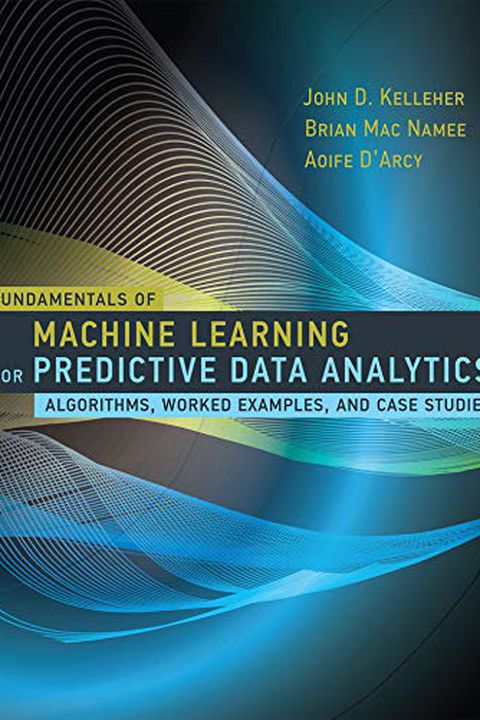
Fundamentals of Machine Learning for Predictive Data Analytics
John D. Kelleher
HandsOn Machine Learning with ScikitLearn, Keras, and TensorFlow
Aurélien Géron
Deep Reinforcement Learning HandsOn
Maxim LapanHow recommendation signals are reviewed
Each recommendation is collected from a public source — interviews, articles, or curated lists — and linked to its original URL. Books with many verifiable recommendations from respected people rank higher.