
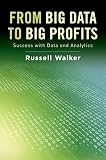
From Big Data to Big Profits
Success with Data and Analytics
by Russell Walker
Reading Profile
Should I read this?
Walker's book reads like a practical business briefing: chapters sketch how companies convert customer data into revenue streams, describe organizational choices, and outline technical and commercial limitations. The useful part is actionable case-style guidance on spotting monetization opportunities and aligning teams; the limiting part is that it stays high-level on implementation, with few hands-on exercises or deep technical blueprints, so readers seeking code, metrics formulas, or step-by-step ops plans will feel teased rather than equipped.
Read this if...
- •head of product at a mid-size SaaS company trying to justify a data-monetization pilot to executives—helps frame revenue models, team roles, and business arguments you can present.
- •business development manager at a retail chain exploring new revenue streams from customer data—offers concrete case examples and commercial approaches to adapt.
- •strategy consultant advising clients on digital transformation who need concise talking points and industry examples to explain data ROI to nontechnical leaders.
Skip this if...
- •You'll likely put it down when chapters gloss over implementation details—if you wanted pipeline diagrams, code snippets, or exact metrics formulas, this book feels unsatisfying.
- •Annoying if you prefer deeply technical manuals: the tone is business-first and case-heavy rather than engineering-oriented.
- •Lose interest if you want an in-depth ethical or legal primer on data privacy and compliance—the book treats privacy as a business constraint, not the central subject.
Technological advancements in computing have changed how data is leveraged by businesses to develop, grow, and innovate. In recent years, leading analytical companies have begun to realize the value in their vast holdings of customer data and have found ways to leverage this untapped potential. Now, more firms are following suit and looking to mone...
Before You Buy
Reading Specifications
Difficulty:easy
Audience Fit
- head of product at a mid-size SaaS company trying to justify a data-monetization pilot to executives—helps frame revenue models, team roles, and business arguments you can present.
- business development manager at a retail chain exploring new revenue streams from customer data—offers concrete case examples and commercial approaches to adapt.
- strategy consultant advising clients on digital transformation who need concise talking points and industry examples to explain data ROI to nontechnical leaders.
- You'll likely put it down when chapters gloss over implementation details—if you wanted pipeline diagrams, code snippets, or exact metrics formulas, this book feels unsatisfying.
- Annoying if you prefer deeply technical manuals: the tone is business-first and case-heavy rather than engineering-oriented.
- Lose interest if you want an in-depth ethical or legal primer on data privacy and compliance—the book treats privacy as a business constraint, not the central subject.
Check formats, pricing, and availability options for Kindle, physical print, or audiobooks directly.
View available editions on AmazonKey themes
Why recommended
appears in Data Science.
Recommendation Signals
Recommendation proof is sourced from public posts, interviews, reading lists, and cited references.
No verified recommendation proof available yet.
Appears In

Not sure if this is the right fit?
Consider Life 3.0 by Max Tegmark. Recommended by 18 sources.
“Life 3.0 reads like a long, wide-ranging conversation with a physicist who loves big if-then thought experiments. The useful part is its panoramic sweep across possible AI futures—from job automation to cosmic colonization—forcing you to consider timelines you might otherwise avoid. The limitation is that the speculative breadth often outruns the depth; chapters can feel meandering, and some readers will find the cosmic-scale scenarios too detached from practical concerns, making it hard to ground in real urgency.”
Similar books
Life 3.0
Max Tegmark
Deep Learning
Ian Goodfellow
Data Science for Business
Foster Provost
Generative Deep Learning
David Foster
Big Data For Dummies
Judith S. Hurwitz
Everybody Lies
Seth StephensDavidowitz
HandsOn Machine Learning with ScikitLearn, Keras, and TensorFlow
Aurélien Géron
Designing DataIntensive Applications
Martin KleppmannHow recommendation signals are reviewed
Each recommendation is collected from a public source — interviews, articles, or curated lists — and linked to its original URL. Books with many verifiable recommendations from respected people rank higher.