
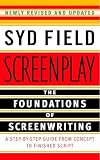
Screenplay
The Foundations of Screenwriting
by Syd Field
Recommended by Cleo Abram and Rolf Potts
Check price on AmazonProof-backed recommendation
Amazon availability
Reading Profile
Should I read this?
A practical, workshop-style manual focused on three-act structure, scene beats, and the mechanics of crafting a market-ready screenplay. Chapters deliver checklists, formatting pointers, and example scenes that make structure tangible for first drafts and rewrites. What works best is its insistence on disciplined plotting and clear act breaks; the main limitation is a tendency toward formulaic repetition and an emphasis on conventional Hollywood expectations that can feel constraining for more adventurous writers. Best used alongside a script you’re actively revising.
Read this if...
- •an aspiring feature-screenwriter drafting a first full-length script who needs a step-by-step map for pacing and act breaks — the book gives concrete beat markers and scene-level advice to follow while writing
- •a film-student preparing a spec or class assignment where demonstrating industry-standard structure matters — the text lays out recognizable beats and formatting cues graders expect
- •a TV writer moving into features who wants quick, practical rules to translate serialized instincts into a tight, three-act outline — useful checklists and examples speed up outlining and pitching
Skip this if...
- •you'll likely put it down when examples and three-act prescriptions start repeating; the mid-section can feel redundant if you already accept the basic structure
- •annoying if you prefer experimental forms or non-linear narratives — the book favors conventional plotting and can come off as formulaic
- •not a fit if you wanted a theory-heavy or academic history of screenwriting; this is practice-focused and sometimes industry-prescriptive rather than analytically deep
A generation of screenwriters has used Syd Field?s bestselling books to ignite successful careers in film. Now the celebrated producer, lecturer, teacher, and bestselling author has updated his classic guide for a new generation of filmmakers, offering a fresh insider?s perspective on the film industry today. From concept to character, from opening...
Before You Buy
Reading Specifications
Difficulty:medium
Audience Fit
- an aspiring feature-screenwriter drafting a first full-length script who needs a step-by-step map for pacing and act breaks — the book gives concrete beat markers and scene-level advice to follow while writing
- a film-student preparing a spec or class assignment where demonstrating industry-standard structure matters — the text lays out recognizable beats and formatting cues graders expect
- a TV writer moving into features who wants quick, practical rules to translate serialized instincts into a tight, three-act outline — useful checklists and examples speed up outlining and pitching
- you'll likely put it down when examples and three-act prescriptions start repeating; the mid-section can feel redundant if you already accept the basic structure
- annoying if you prefer experimental forms or non-linear narratives — the book favors conventional plotting and can come off as formulaic
- not a fit if you wanted a theory-heavy or academic history of screenwriting; this is practice-focused and sometimes industry-prescriptive rather than analytically deep
Check formats, pricing, and availability options for Kindle, physical print, or audiobooks directly.
View available editions on AmazonKey themes
Why recommended
Recommended by 3 sources and appears in Screenplay, Screenwriting, and Filmmaking.
Recommended by notable people
People and public figures who have recommended this book.
Recommendation Signals
Recommendation proof is sourced from public posts, interviews, reading lists, and cited references.
Appears In

Not sure if this is the right fit?
Consider The Hero with a Thousand Faces by Joseph Campbell. Recommended by 14 sources.
“Campbell’s work reads like a dense academic tour through world mythology, cataloging the hero’s journey in exhausting detail. You’ll encounter countless myths, rituals, and symbols tied to a common monomyth pattern. The main value lies in its ability to unveil the deep structure beneath disparate stories, from ancient epics to modern dreams. Annoyingly, the prose is thick with Jungian and Freudian interpretation, and the comparative method can feel repetitive and overreaching. It’s a book to study, not to skim—rewarding for the patient, cloying for the skeptical.”
Similar books
The Writers Journey
Christopher VoglerThe Hero with a Thousand Faces
Joseph Campbell
Adventures in the Screen Trade
William Goldman
Three Uses of the Knife
David MametOn Writing
Stephen King
Steal Like an Artist
Austin Kleon
Big Magic
Elizabeth Gilbert
Story Structure Architect
Victoria Lynn SchmidtHow recommendation signals are reviewed
Each recommendation is collected from a public source — interviews, articles, or curated lists — and linked to its original URL. Books with many verifiable recommendations from respected people rank higher.