
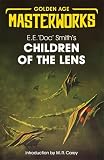
Children of the Lens
by Edward E. Smith
Reading Profile
Should I read this?
A breathless, high-stakes space opera that pits cosmic annihilation against one last stratagem to save civilization. Edward E. Smith keeps the plot moving through relentless battles, broad-stroke heroes and planetary-scale threats centered on Kim Kinnison and the Galactic Patrol. Its strength is straightforward, scene-driven momentum — set pieces and tactical gambits that deliver spectacle. Its limitation is schematic prose and repetitive expository stretches that undercut character nuance. Best when you want escapist, old-fashioned SF energy rather than subtle psychological realism.
Read this if...
- •a software engineer with a two-day holiday who wants an 8–12 hour escapist binge of pulpy space battles to decompress before a tight project deadline — good for zoning out into straightforward plotting without emotional heavy-lifting
- •an early-career science-fiction writer drafting a space-opera outline ahead of a workshop or submission deadline who needs concrete examples of large-scale escalation, tactical gambits, and how to stage planetary-scale conflicts right now
- •a tabletop-RPG gamemaster prepping an interstellar campaign session next month who wants ready-to-adapt antagonists, decisive stakes, and set-piece encounters to drop into maps and encounter notes
Skip this if...
- •you prefer introspective character studies — you'll likely put it down when the narrative repeatedly favors spectacle and exposition over inner life
- •you expect modern, economical prose — annoying if you dislike schematic, repetitive exposition and an older pacing sensibility
- •you want hands-on exercises or deep psychological nuance — no exercises and limited emotional subtlety
It was beginning to look as though no one could prevent the annihilation of the civilized Universe. For a weird intelligence was directing the destruction of all civilization from the icy depths of outer space.Kim Kinnison of the Galactic Patrol was one of the few men who knew how near the end was. And in the last desperate stratagem to save the Un...
Before You Buy
Reading Specifications
Difficulty:easy
Audience Fit
- a software engineer with a two-day holiday who wants an 8–12 hour escapist binge of pulpy space battles to decompress before a tight project deadline — good for zoning out into straightforward plotting without emotional heavy-lifting
- an early-career science-fiction writer drafting a space-opera outline ahead of a workshop or submission deadline who needs concrete examples of large-scale escalation, tactical gambits, and how to stage planetary-scale conflicts right now
- a tabletop-RPG gamemaster prepping an interstellar campaign session next month who wants ready-to-adapt antagonists, decisive stakes, and set-piece encounters to drop into maps and encounter notes
- you prefer introspective character studies — you'll likely put it down when the narrative repeatedly favors spectacle and exposition over inner life
- you expect modern, economical prose — annoying if you dislike schematic, repetitive exposition and an older pacing sensibility
- you want hands-on exercises or deep psychological nuance — no exercises and limited emotional subtlety
Check formats, pricing, and availability options for Kindle, physical print, or audiobooks directly.
View available editions on AmazonKey themes
Why recommended
appears in Space Opera, Science Fiction, and Science.
Recommendation Signals
Recommendation proof is sourced from public posts, interviews, reading lists, and cited references.
No verified recommendation proof available yet.
Appears In

Not sure if this is the right fit?
Consider Leviathan Wakes by James S. A. Corey. Recommended by 3 sources.
“Leviathan Wakes reads like a brisk, cinematic space-opera that shifts between a small-crew survival story and a widening conspiracy with real political consequences. Its strengths are propulsive plotting, street-level detail of life across Mars, the Belt and Earth, and a cast that grounds big-idea threats in personal stakes. Limitations: an abrupt tonal late-book escalation that favors spectacle over subtlety, and some exposition-heavy stretches that will frustrate readers wanting quieter character study or tighter hard-SF rigor.”
Similar books
How recommendation signals are reviewed
Each recommendation is collected from a public source — interviews, articles, or curated lists — and linked to its original URL. Books with many verifiable recommendations from respected people rank higher.