
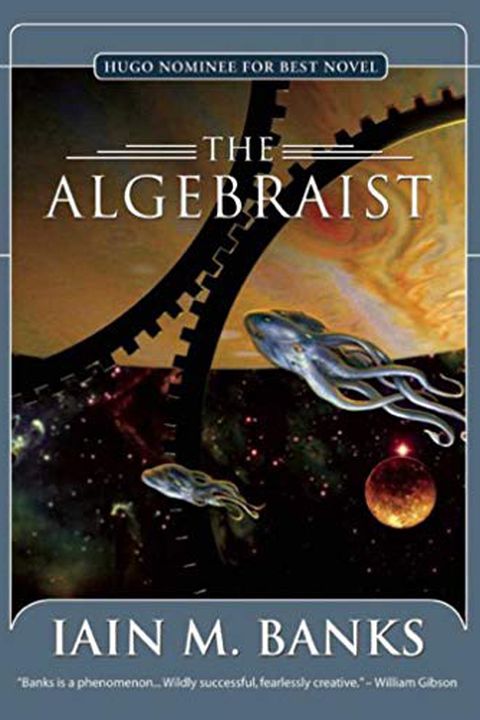
The Algebraist
by Iain M. Banks
Reading Profile
Should I read this?
Reading The Algebraist feels like sinking into a vast, slowly unfurled cosmic puzzle: immersive worldbuilding, long descriptive passages, and a protagonist positioned as a 'Slow Seer' that signals the novel's patience-based rewards. Main value is sustained, imaginative alien sociology and a galaxy-scale political backdrop that gives small details heft. Main limitation is tempo: extended digressions and thick exposition repeatedly slow forward momentum. Best approached by readers who enjoy unpacking layered detail rather than seeking immediate narrative propulsion.
Read this if...
- •a fiction writer drafting an alien-society novel who needs concrete examples of nonhuman institutions and unusual lifespans — because the book piles inventive social detail you can study.
- •a reader recovering from fast-paced thrillers with several free evenings over weeks, wanting a slow, immersive detour — because the novel rewards patient attention rather than sprint reading.
- •a university seminar leader teaching speculative worldbuilding who wants a dense text to provoke class debates about alien politics, secrecy, and long-term timelines.
Skip this if...
- •You’ll likely put it down when long expository chapters interrupt plot momentum — annoying if you want a tight, plot-driven narrative.
- •Lose interest if you want intimate, emotionally immediate character arcs — this prioritizes ideas and sociological detail over close psychological portraiture.
- •Annoying if you dislike heavy invented terminology and extended digressions — repetitive neologisms and encyclopedic passages can feel indulgent and slow the book to a crawl.
It is 4034. Humanity has made it to the stars. Fassin Taak, a Slow Seer at the Court of the Nasqueron Dwellers, will be fortunate if he makes it to the end of the year. The Nasqueron Dwellers inhabit a gas giant on the outskirts of the galaxy, in a system awaiting its wormhole connection to the rest of civilization. In the meantime, they are dismis...
Before You Buy
Reading Specifications
Difficulty:hard
Audience Fit
- a fiction writer drafting an alien-society novel who needs concrete examples of nonhuman institutions and unusual lifespans — because the book piles inventive social detail you can study.
- a reader recovering from fast-paced thrillers with several free evenings over weeks, wanting a slow, immersive detour — because the novel rewards patient attention rather than sprint reading.
- a university seminar leader teaching speculative worldbuilding who wants a dense text to provoke class debates about alien politics, secrecy, and long-term timelines.
- You’ll likely put it down when long expository chapters interrupt plot momentum — annoying if you want a tight, plot-driven narrative.
- Lose interest if you want intimate, emotionally immediate character arcs — this prioritizes ideas and sociological detail over close psychological portraiture.
- Annoying if you dislike heavy invented terminology and extended digressions — repetitive neologisms and encyclopedic passages can feel indulgent and slow the book to a crawl.
Check formats, pricing, and availability options for Kindle, physical print, or audiobooks directly.
View available editions on AmazonKey themes
Why recommended
Recommended by 1 source and appears in Space Opera, Science Fiction, and Science.
Recommended by notable people
People and public figures who have recommended this book.
Recommendation Signals
Recommendation proof is sourced from public posts, interviews, reading lists, and cited references.
Geoffrey Miller
“I'm reading this book for the second time & love it so much it hurts. If you want an escape from the mass insanity of 2020, & a vision of a longterm future worth fighting for, read it.”
Appears In

Not sure if this is the right fit?
Consider Leviathan Wakes by James S. A. Corey. Recommended by 3 sources.
“Leviathan Wakes reads like a brisk, cinematic space-opera that shifts between a small-crew survival story and a widening conspiracy with real political consequences. Its strengths are propulsive plotting, street-level detail of life across Mars, the Belt and Earth, and a cast that grounds big-idea threats in personal stakes. Limitations: an abrupt tonal late-book escalation that favors spectacle over subtlety, and some exposition-heavy stretches that will frustrate readers wanting quieter character study or tighter hard-SF rigor.”
Similar books
How recommendation signals are reviewed
Each recommendation is collected from a public source — interviews, articles, or curated lists — and linked to its original URL. Books with many verifiable recommendations from respected people rank higher.